Okinawa doesn't feel like Japan. It feels like a secret the world is only just beginning to find.
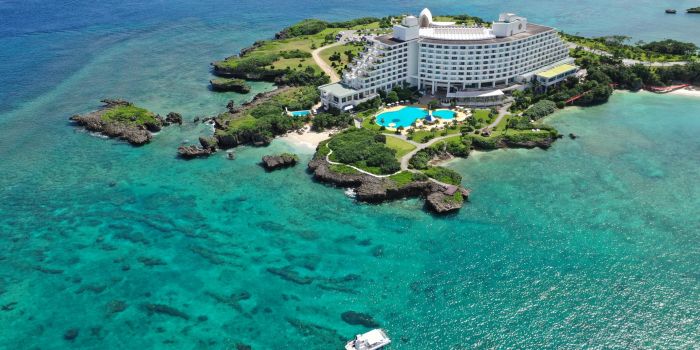
There is a color of water that exists only in one place on earth. Locals call it Kerama Blue — a shade so improbably saturated, so lit from within, that the first time you wade into it you genuinely wonder if the sea has been doctored somehow.
It hasn't. This is just Okinawa.
Japan's southernmost archipelago sits 1,500 kilometers from Tokyo, halfway between the Japanese mainland and Taiwan, in a stretch of Pacific where the water is warm, the sky is wide, and the history runs deeper than most travel articles bother to go. Expedia reported a 71 percent surge in search interest for Okinawa in the lead-up to 2026 — one of the sharpest spikes of any destination on the planet. People are catching on. But catching on to what, exactly?
That's the question worth answering properly.
A Kingdom That Japan
Only Annexed 145 Years Ago
Most travelers arrive in Okinawa expecting a tropical version of Japan. What they find instead is something far more disorienting and far more interesting: a civilization with its own language, its own gods, its own cuisine, and its own 450-year history as an independent kingdom that traded freely between China, Japan, Korea, and Southeast Asia — and belonged fully to none of them.
The Ryukyu Kingdom was born in 1428 when the islands were unified under King Shō Hashi. For the next four and a half centuries, this small archipelago operated as a crucial nexus of Asian maritime trade. Merchants and emissaries came from everywhere. The Ryukyuans absorbed Chinese architecture, Southeast Asian spices, Japanese aesthetics, and blended all of it into something entirely their own. The food became medicine. The music became ceremony. The castles became statements of a culture that refused to be merely peripheral.
"Japan annexed Okinawa in 1879. The Ryukyuan identity didn't disappear. It went underground — and it's been quietly surfacing ever since."
Walk through Naha's older neighborhoods today and you'll still see shisa — the lion-dog guardians — perched on red-tiled rooftops, their mismatched expressions (one open-mouthed to invite good fortune, one closed-mouthed to keep evil out) staring down at streets where elderly men still play the sanshin, a three-stringed instrument descended from a Chinese ancestor but played in a way that sounds like nowhere else on earth. These are not performances put on for tourists. They are just Tuesday.
Nine structures from the Ryukyu Kingdom are UNESCO World Heritage Sites. The most famous among them, Shuri Castle, is the red-pillared, Chinese-influenced royal palace that sits above Naha like a crown. It was devastated by fire in 2019 — a moment that shook Okinawans deeply — but restoration is ongoing and meaningful sections are accessible, their lacquered walls and ornate stonework still carrying the particular gravity of a place where kings once held court.
The Water. Let's Talk About the Water.
Thirty-five minutes by high-speed ferry from Naha's Tomari Port, the Kerama Islands wait. This cluster of more than 30 islands — designated a national park in 2014 — holds what marine researchers and divers quietly regard as some of the most intact coral reef ecosystems anywhere in the Pacific. Visibility can exceed 40 meters on a clear day. The water is not just clear. It is transparent in a way that makes you feel weightless even standing chest-deep.
On Zamami Island, Furuzamami Beach carries a Michelin Green Guide two-star rating — a recognition awarded not by chefs but by cartographers and travel editors who reserve it for places of genuine natural magnificence. Ama Beach, a 15-minute walk from the port in the opposite direction, is shallower and calmer, and at high tide, sea turtles come in to feed. Not occasionally. Regularly. You do not pay to see this. You simply walk to the water's edge and wait.
Aka Island, the smallest of the inhabited Keramas with only around 260 permanent residents, has no convenience stores, one ATM, and beaches that feel genuinely untouched. Hizushi Beach on the island's western side faces the sunset directly. There is a small diving shop. There is a beer available from a cooler. The sun goes down over the East China Sea and you understand, perhaps for the first time, what the word quiet actually means.
Between January and March, humpback whales migrate into Kerama waters to calve. Half-day whale-watching boats run from Naha's port, and the encounters are not sightings from a distance — these are animals the size of buses, surfacing close enough that you feel the displacement of water when they breach. Children laugh. Adults go quiet.
The Food That Makes People Live
Past One Hundred
Okinawa is one of the world's Blue Zones — a small cluster of regions where people routinely live past 100 years in good health. The others are Sardinia, Nicoya in Costa Rica, Ikaria in Greece, and Loma Linda in California. But Okinawa's longevity culture is perhaps the most studied of all, and the cuisine is where it begins.
The Ryukyuan philosophy of food is called nuchigusui — literally "food as medicine." It is rooted in centuries of Chinese medicinal influence combined with the particular abundance of a subtropical island: abundant fresh fish, purple sweet potatoes loaded with antioxidants, fermented soy in forms distinct from mainland Japan, bitter gourd called goya that Okinawans eat as casually as mainlanders eat cabbage, and tofu prepared in a firmer, more protein-dense style that survives being stir-fried into everything.
Rafute — pork belly braised for hours in awamori, soy sauce, and brown sugar until it collapses into something between meat and silk. The Ryukyu Kingdom's table classic, and still the dish that defines the island.
Okinawa soba — wheat noodles (not buckwheat, despite the name) in a clear pork-and-katsuobushi broth, topped with a slow-cooked pork rib called soki. Add a splash of chili-soaked awamori from the table condiment jar and everything changes.
Umi-budo — sea grapes: clusters of translucent green algae that pop in your mouth like underwater pearls, served cold with ponzu. Called the "caviar of the sea" for exactly the right reasons.
Taco rice — a wildly specific Okinawan invention from the 1980s: taco-seasoned beef, shredded cheese, lettuce, salsa, and sour cream over white rice. Born to feed American servicemen at the bases surrounding Naha. Now beloved everywhere, unapologetically, as authentic Okinawan comfort food.
Awamori — the island's centuries-old distilled rice spirit, 25–43% ABV, aged in clay pots and tasting nothing like sake. Some distilleries age it in caves underground. Sip it straight, over ice, or ask at any izakaya for mizu-wari — cut with water and drunk slowly through a meal.
In Ogimi Village in northern Okinawa, officially recognized as the "Village of Longevity," elderly women still maintain communal vegetable gardens. The local diet there remains closest to its traditional form — low in calories, high in nutrients, consumed in the measured quantities described by the Okinawan concept of hara hachi bu: eat to 80 percent full, then stop. Researchers who have studied Okinawan centenarians consistently find not just their diet but their social fabric — strong community bonds, purposeful daily life, deep connection to land and sea — is equally responsible for their extraordinary health.
You can taste this in a bowl of soba from a family-run shop in Nago, the broth made from a recipe passed down through four generations, the pork rib braised since five in the morning. The food here is not a performance of tradition. It is tradition, still alive in the kitchen.
Beyond the Main Island:
Where the Okinawa Nobody Talks About Lives
The main island, connected to Naha, is where most travelers stay. It has its charms — the Kokusai-dori shopping street with its sata andagi (Okinawan fried doughnut balls, crisp outside, fluffy inside, dusted with sugar and sold warm), the 350-year-old Tsuboya Pottery District with its working kilns and earthenware shisa, the vast Churaumi Aquarium where whale sharks drift through a tank so large it takes a moment to locate the far wall. These are worth your time.
But the real Okinawa spreads south and west into the Yaeyama Islands, a one-hour flight from Naha to Ishigaki and from there a ferry into places that make even the Keramas seem crowded.
Iriomote Island — UNESCO-listed, nicknamed the "Galápagos of the East" — is 90 percent subtropical jungle. Almost no roads. The island is crossed by kayak along its longest river, the Urauchi, through mangrove forest so dense the canopy closes overhead and the only sounds are water and birds. Pinaisara Falls, at the island's northern tip, drops 55 meters into a pool that you can swim in after a two-hour jungle trek that feels, in the best possible way, like it belongs to a different century. Somewhere in those forests lives the Iriomote wildcat — an endemic species found nowhere else on earth, nocturnal, elusive, spotted perhaps a handful of times by lucky visitors. The island has fewer than 2,500 permanent residents.
Taketomi Island, reachable by a ten-minute ferry from Ishigaki, is tiny — roughly nine square kilometers — and among the most deliberately preserved places in Japan. No buildings taller than a single story. No traffic except water buffalo carts that carry tourists slowly down lanes of crushed white coral between walls draped in bougainvillea. The roads are not paved. The stars at night are extraordinary.
"On Taketomi Island, the roads are made of crushed white coral and the water buffalo set the pace. There is no hurry here, and no pretending otherwise."
In Yomitan Village on the main island, the Yuntanza-Hanaui textile tradition dates from the 15th century, when weavers produced cloth for the royal court using threads dyed with Ryukyu indigo and fukugi bark. The motifs carry meaning: coins for prosperity, fans for descendants, windmills for long life. Today, workshops still teach the craft to anyone willing to spend a morning at a loom. The process is slow and meditative and produces something genuinely beautiful. You will want to bring it home. It will not fit in your suitcase and you will buy it anyway.
The Okinawans Themselves
There is a word in Okinawa — ichariba choodee — that translates roughly as "once we meet, we are family." It is not a slogan. It is a lived social philosophy, and it shapes the particular quality of welcome you receive here in ways that are distinct even within Japan, a country already known internationally for its hospitality.
Okinawans are genetically related to mainland Japanese but culturally distinct, their identity rooted in the Ryukyuan civilization with its historically closer ties to Southeast Asia and southern China. Younger Okinawans navigate a complex identity — Japanese nationals, heirs to a separate culture, inhabitants of islands that bore a disproportionate burden during the Second World War and have housed American military bases ever since. This complexity has not made them bitter. It has made them thoughtful.
Sit down at a family-run izakaya in Naha's side streets, order awamori and rafute, and the owner will likely come out eventually and sit with you. Not to upsell. Just to talk. This happens with enough regularity that experienced travelers start building extra time into their evenings for exactly this.
Best time to visit: May through October for beaches and snorkeling (ocean warm, typhoon risk July–September). January through March for whale watching and cooler, crowd-free exploration. The Okinawan cherry blossoms — among Japan's earliest — bloom in January and February, while mainland Japan still shivers.
Getting there: Naha Airport (OKA) is served by direct flights from Tokyo (about 2.5 hours), Osaka, and several other major Asian hubs. The weak yen in 2026 makes Japan broadly affordable for international visitors — budget roughly $150–250 USD per day for a comfortable mid-range experience including accommodation, food, ferries, and activities. Luxury resorts push higher; backpacker guesthouses and minshuku (family-run inns) bring it lower.
Getting around: Rent a car on the main island — the Yui Rail monorail covers central Naha, but the island's best experiences require driving north. For the outer islands, inter-island ferries are frequent and scenic. Ishigaki Airport connects Okinawa's remote south to Naha in one hour.
Key costs to know: Kerama ferry (round-trip, Naha to Zamami) approximately ¥5,000–6,500. Churaumi Aquarium admission ¥2,180 adults. Shuri Castle ¥400 adults. A quality dinner in a local izakaya with awamori: ¥2,500–4,000 per person. A bowl of Okinawa soba from a family shop: ¥700–900.
Cultural notes: Learn one phrase in Uchinaaguchi (the Ryukyuan language) — haisai (hello, used by men) or haitai (hello, used by women). Locals will be genuinely delighted. Respect the distinction between Okinawan and Japanese identity — they are proud of both, but the Ryukyuan heritage is not an afterthought. At Eisa dance festivals in August, do not merely observe — participation is welcomed.
Why Now
Okinawa is trending because the travel market is maturing. The era of the Instagram landmark — fly in, photograph the blue dome, fly out — is losing ground to something more difficult to commodify: genuine experience. Places where the culture is not performed for visitors but simply lived. Where the food is not fusion but lineage. Where the water has a name because it earned one.
The weak yen in 2026 has made Japan broadly accessible to Western travelers in a way not seen for a generation. Tokyo and Kyoto absorb the bulk of this attention. Okinawa, for now, does not. The Kerama Islands on a weekday in late May hold perhaps a few hundred visitors across a national park of 30-plus islands. The beach at Ama where the sea turtles feed is shared, on a good day, between a family of four and a solo diver rinsing her equipment at the outdoor shower. The izakaya in Naha's backstreets still have tables available without reservations at 7pm.
This will change. It is already changing. Which means the calculus is simple.
Go now. Go before the Kerama Blue gets a line.
One last thing. On your last morning — before the taxi, before the airport, before the flight back to wherever you came from — find a spot on the coast facing west. Watch the sun come up over the hills behind you and turn the water gold for approximately eleven minutes. There will be an old man nearby, doing his morning exercises with the focused tranquility of someone who has been doing this for decades and intends to do it for decades more. He will not acknowledge you. You will not need him to. You will understand, in that quiet, why people who come here tend to come back.


0 nhận xét:
Post a Comment