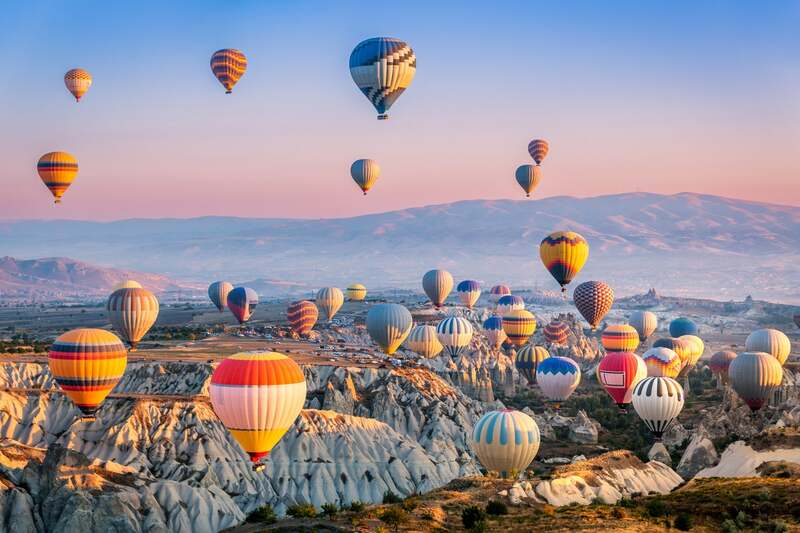
There is a precise moment, just as the night’s cool indigo grip loosens over the Anatolian plateau, when the world holds its breath. Stand on a high ridge of volcanic tufa in the early hours of a June morning, and the silence is so heavy you can hear the soft, rhythmic hiss of propane burners echoing across the valleys like the respiration of sleeping giants. Then, as the sun edges over the distant Erciyes Volcano, the sky blushes into shades of bruised apricot and dusty rose. Suddenly, the horizon fills. Hundreds of hot air balloons swell and rise into the crisp, thin air, their multi-colored silk envelopes casting long, drifting shadows over a landscape that defies earthly geometry.
The air smells faintly of wild thyme, damp volcanic stone, and the rich, woodsy smoke of open-fire breakfasts being prepared in the valleys below. It feels less like an earthly destination and more like a half-remembered dream sequence, a place where time has been carved out by the elements and human hands over millennia into an architectural masterpiece of fairy chimneys, subterranean sanctuaries, and hidden orchard valleys.
While global travel trends have thrust this central Turkish wonderland onto every bucket list imaginable, a new wave of discerning international travelers is looking beyond the standard snapshot. They are searching for the quiet pulse of a region that exists beneath the famous skyline—a place of ancient troglodytic lifestyles, micro-climate vineyards, and a spirit of hospitality that remains fiercely unchanged since the days of the Silk Road.
The Architecture of Time and Faith
To understand Cappadocia is to understand the slow, patient choreography of wind, water, and fire. Millions of years ago, volcanic eruptions blanketed this region in thick ash, which solidified into a soft, porous rock known as tufa. Over centuries, the relentless Anatolian winds and sudden torrential rains carved this stone into the iconic, towering spires locally known as peri bacaları, or fairy chimneys. But the true magic began when humanity realized that this stone, while durable against the elements, yielded beautifully to the chisel.
This is a landscape carved from the inside out. During the iconoclastic periods of early Christianity, thousands of devout souls hollowed out entire monastery complexes, chapels, and hidden living quarters within these stone pillars. Walking into the dark, cool interior of a rock-cut church like the Dark Church (Karanlık Kilise), your eyes adjust to reveal breathtaking, 11th-century Byzantine frescoes that remain astonishingly vivid, their lapis lazuli pigments preserved by the absolute darkness of the stone vaults.
The physical connection to history here is tactile; you can run your fingers over the smooth, chiseled indentations left by a monk’s hand nearly a thousand years ago, feeling the cool, insulating properties of the earth that kept these sanctuaries safe from both the searing summer heat and the bitter winter snows.
Secret Valleys and Living Clay
Beyond the crowded viewing decks, the true essence of the region reveals itself along the winding, dusty paths of the Rose Valley (Güllüdere). As midday approaches, the stone shifts through an extraordinary spectrum of pastel pinks, deep reds, and mineral greens. If you leave the main trail, you stumble upon small, secluded apricot orchards and ancient vineyards tended by local farmers who still use traditional methods, using pigeon droppings from rock-cut dovecotes as a rich, organic fertilizer.
Further north, along the banks of the Red River (Kızılırmak), lies the bohemian town of Avanos. Here, the red silt of the riverbed has fueled a pottery tradition that has run continuously since the Hittite Empire. Stepping into a subterranean workshop, the air is cool and heavy with the mineral scent of wet earth. Watch an old master potter kick a heavy wooden wheel with his bare foot, his hands moving with fluid, practiced grace to transform a lump of rough red clay into an elegant, slender-necked wine vessel in a matter of seconds. The local culture here is intimately bound to the earth; the clay isn't just a medium for art—it is the historical lifeblood of the community.
The Alchemy of the Anatolian Hearth
Cappadocian gastronomy is an exercise in patience, a culinary tradition defined by the slow, subterranean heat of traditional clay ovens called tandır. The definitive signature dish of the region is Testi Kebabı (Pottery Kebab), a culinary theatrical performance that tastes as rich as the history surrounding it. Lean chunks of local lamb or beef are sealed inside a custom-made, unfired clay pot along with ripe tomatoes, garlic, shallots, and a rich blend of Anatolian spices. The pot is then placed deep into the embers of a wood fire, where it braises slowly in its own pressurized steam for hours.
When the dish is brought to your table, the server uses a small mallet to cleanly crack the neck of the steaming clay pot right before your eyes. The immediate aroma that escapes is intoxicating—a cloud of rich, garlic-infused steam and woodsmoke. The meat inside is so extraordinarily tender it behaves like velvet on the palate, carrying a deep, earthy flavor infused with the mineral character of the very clay vessel it was cooked in.
Pair this with a glass of local Öküzgözü or Boğazkere wine, harvested from ancient, ungrafted vines grown in the mineral-heavy volcanic soil of the surrounding valleys, and you are tasting the literal terroir of Cappadocia.
An Insider’s Blueprint for Exploration
To experience this volcanic sanctuary without the friction of conventional tourism, timing and location are paramount. The sweet spot for visiting falls within the crisp autumn months from September to November, or the brilliant spring window of May and June. During these transitional periods, the daytime temperatures hovering around 22°C are perfect for deep valley trekking, the air is exceptionally clear for ballooning, and the evening breeze carries a pleasant, cozy chill.
Navigating the Terrain
Most international travelers fly into Istanbul before catching a brief, one-hour domestic flight to either Nevşehir Kapadokya Airport or Kayseri Erkilet Airport. Nevşehir is closer, offering a seamless thirty-minute private transfer into the central hotel zones, while Kayseri provides a wider selection of flight times. While public minibuses (dolmuş) run between the main towns, the most liberating way to discover hidden trailheads and remote archaeological sites is by arranging a private vehicle or booking a local guide who understands the intricate trail systems of the less-frequented valleys.
Accommodation and Budgeting
For an authentic stay, bypass standard modern resorts and choose a boutique cave hotel carved directly into the cliff faces of Göreme, Uçhisar, or the quieter town of Ortahisar. These properties offer luxury suites featuring original stone archways, open fireplaces, and private terraces that provide frontline views of the morning balloon flights.
A premium cave suite averages between $150 and $350 per night.
A traditional multi-course dinner with local wine ranges from $30 to $55 per person.
A signature hot air balloon flight varies between $120 and $220 depending on flight duration and basket capacity.
Essential Cultural Insights and Missteps to Avoid
The people of this region, the Kapadokyalılar, possess a gentle, unhurried pride that is characteristic of the Turkish heartland. Hospitality is not a transaction here; it is a cultural pillar. If a local potter or carpet weaver offers you a small tulip-shaped glass of steaming hot apple tea (elma çayı), accept it with gratitude. It is an invitation to converse, a sign of respect, and taking a slow sip while sitting on a hand-woven kilim rug is the universal gateway to authentic local storytelling.
A common mistake made by hurried travelers is treating the landscape purely as a background for photos, spending only a single night before rushing to the coast. Cappadocia requires time to settle into your consciousness. Give yourself at least three full days to explore.
Additionally, ensure you pack sturdy, high-grip hiking boots; the volcanic tufa can be incredibly slippery and loose underfoot, especially when climbing into unlit, non-fenced cave churches. Finally, remember that while these caves may look like abandoned ruins, many are precious historical sites or private properties; treat them with the same reverence you would show to a modern cathedral or an active home.
The Lasting Impression
Long after you have returned home, when the dust on your traveling boots has dried and the photographs have been sorted, it is the sensory memories of this volcanic sanctuary that will keep calling you back. You will remember the precise chill of the morning air against your face as a balloon basket lifted effortlessly off the ground.
You will remember the rich, savory taste of a slow-cooked kebab shared in a subterranean cavern, and the quiet dignity of an old artisan turning clay on a spinning wheel. Cappadocia is not just a destination to be ticked off a list; it is a profound shift in perspective, an ancient landscape that reminds us of what happens when nature and humanity collaborate to create something truly extraordinary. You need to experience this for yourself.

_(cropped).jpg)


