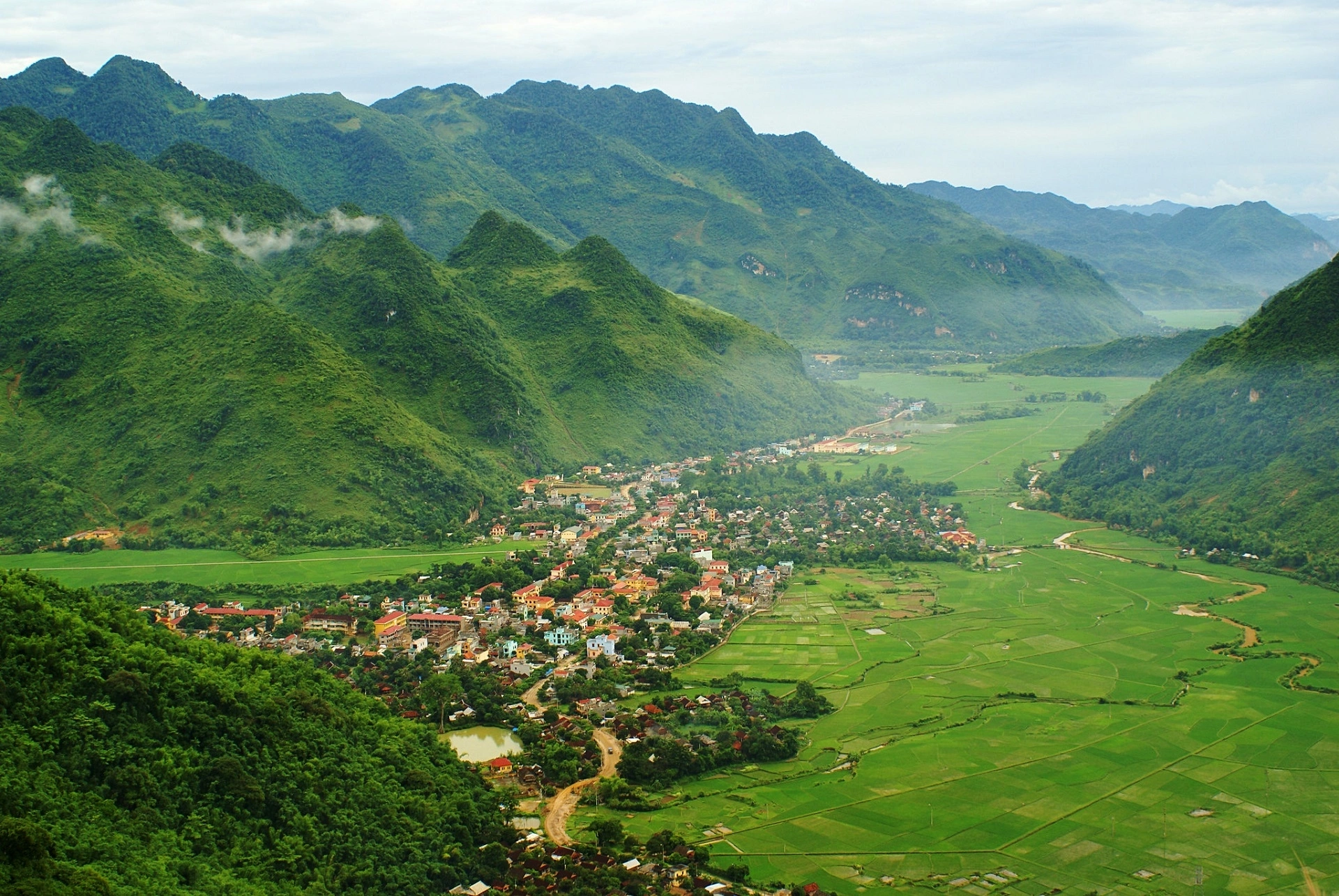
Step away from the asphalt highway at the crest of the Thung Khe Pass, just as the afternoon light begins to shatter across the valley floor. If you breathe in deeply, you are hit by a sensory signature that feels entirely separated from the heavy coastal humidity or the intense, metallic energy of northern city centers. The air here has a soft, woven texture—cool, thin, and carrying the distinct aroma of toasted sweet rice, charred bamboo husks, and the clean, herbal perfume of raw indigo leaves fermenting in giant wooden vats behind stilt houses.
Look straight down into the great green bowl of the valley. The morning fog doesn’t simply clear; it unravels from the landscape like a raw silk thread, revealing a perfectly level mosaic of emerald paddies split by small dirt dykes.
For the contemporary international traveler, the heavily trafficked mountainous paths of Sapa or the crowded cruise lines of the bays are beginning to feel like variations of a story already told. Conscious wanderers from North America and Western Europe are actively looking for destinations that offer an authentic tribal presence without the overwhelming commercial footprint. Real-time travel indicators reveal a significant surge in premium searches focused on Mai Châu District—a peaceful valley sanctuary located in Hòa Bình Province, the ancient ancestral gateway to Vietnam's northwest highlands.
Mai Châu is a beautiful lesson in cultural preservation. Protected by a steep rim of limestone hills, this fertile basin is the geographic heartland of the White Thai (Tay Dam and Tay Don) people, who have inhabited these timber stilt houses for over seven centuries. It is capturing the global imagination precisely because it rejects the frantic pace of modern itineraries, offering instead an exquisite, slow-motion immersion into an indigenous lifestyle where time is measured by the growth of the rice and the rhythm of the loom.
The Master of the Foot-Pedal: Geometry, Lineage, and the Indigo Hand
To understand the human landscape of Mai Châu, one must abandon the central market and walk into the quiet, shaded hamlets of Bản Lác or Bản Pom Coọng. Here, beneath the high floors of the traditional ironwood stilt houses (Nhà Sàn), the valley's true art form is practiced in plain sight.
The traditional White Thai loom is a massive, hand-carved timber contraption that occupies the cool shade beneath the family home. The women who operate them possess a striking, unhurried precision. Watching an elder artisan work is like watching a master musician execute a complex score. Her bare feet move rhythmically across the worn wooden foot-pedals while her hands slide a bamboo shuttle back and forth through hundreds of thin silk threads with a speed that defies the eye.
The character of the White Thai people is wonderfully gentle, hospitable, and characterized by a profound, collective modesty. They do not approach visitors with the intense commercial persistence found in other mountain towns; they welcome you with an open, quiet grace.
If you stop to admire the geometric red-and-black patterns of a half-finished textile, the weaver will likely look up with clear, crinkling eyes and motion for you to climb the solid wooden ladder into her home. There, on a beautifully swept floor of polished bamboo splits, she will serve you a cup of warm water infused with wild forest roots, sharing her space without needing to sell you a thing. Through her presence, you understand that these hand-woven patterns are not souvenirs—they are a visual language holding the history of her lineage.
The Fire of the Bitter Bamboo: Earth Smoke, Wild Herbs, and Sticky Rice
The culinary map of Mai Châu is deeply tied to the daily harvest of the forest and the unique water-management traditions of the valley floor. It is a cuisine that values natural steaming, leaf-wrapping, and the intense aromas of open woodfires.
The Sweet Perfume of Cơm Lam
The defining culinary encounter of a Mai Châu morning is Cơm Lam (Bamboo-Tube Sticky Rice). Local fragrant upland rice is mixed with fresh coconut milk and a scattering of wild black beans, then packed tightly into hollow sections of young green Nứa bamboo harvested from the mountain slopes. The open ends are sealed with fresh banana leaves, and the tubes are roasted over low wood coals, turning them slowly until the outer bark is completely blackened. When sliced open, the outer layer of rice retains a thin, delicate inner skin from the bamboo lining. The first bite offers a stunning contrast: a smoky, woody outer crust that gives way to a sweet, intensely fragrant, and velvety core.
The Herbal Intensity of Thịt Lợn Mán Nướng Lá Móc Mật
Equally unforgettable is the native black pig (Lợn Mán), raised naturally in the mountain villages. Slices of tender pork are marinated in a pungent mixture of crushed lemongrass, wild ginger, and—most importantly—the bruised leaves of the Móc Mật (wampi) tree, a native mountain plant known for its citrusy, peppery aroma. The meat is wrapped inside whole banana leaves and slow-cooked over wild charcoal until the fat liquefies into the herbs. It is rich, smoky, and intensely savory, traditional food built to complement the crisp mountain beer at twilight.
The Secret Fabric: Unlocking Forgotten Caves and Weaving Villages
While the central valley paths attract casual cyclists, the true, untouched magic of Mai Châu reveals itself to those who travel toward the outer edges where the mountains meet the clouds.
The Subterranean Cathedral of Chều Cave
To experience a moment of pure, isolated exploration, climb the 1,200 stone steps up the limestone cliff face to the entrance of Hang Chều (The Cave of Morning Sunbeams). The trek up through the wild forest is exhausting, but the reward is immense. The cave breaks open into a massive, two-tiered underground chamber stretching over a kilometer into the mountain. Because of the cave's unique western exposure, around four in the afternoon, the setting sun penetrates deep into the darkness, illuminating towering fields of ancient stalactites in a surreal, golden light. Standing alone in that vast, echoing stone cathedral as the sunbeams slice through the dust motes feels like standing inside a forgotten temple.
The Lost Valley of Hịch
For an experience completely removed from modern lodging infrastructure, follow the river track southwest to the remote village cluster of Mai Hịch. Here, the modern world fades entirely. The village remains an active agricultural community where the White Thai families live alongside the Xia River. Rent a simple bamboo raft steered by a local farmer using a long pole, and glide silently down the crystal-clear stream. The only sound is the water rushing over the pebbles, the low call of ducks in the water-lettuce patches, and the distant, rhythmic thumping of water-powered wooden pestles hulling rice in the fields.
The Weaver’s Ledger: Practical Intelligence for the Slow Valley
The Agricultural Clock
Mai Châu alters its visual personality completely based on the agricultural calendar. The absolute premier window for international travelers seeking optimal trekking conditions and the iconic green landscape is from March to May, when the valley is filled with uniform, emerald-green rice plants and the wild plum trees are in bloom. Alternatively, visiting in late September and October offers a spectacular visual transformation, as the entire basin turns into an absolute sea of gold just before the autumn harvest. The winter months from December to February bring a cold, atmospheric mist that wraps the limestone peaks in mystery, though you must pack heavy layers for the drop in night temperatures.
The Transit Path
Accessing this highland sanctuary is remarkably smooth, making it an excellent option for travelers wanting to avoid long-haul transit exhaustion. Located approximately 85 miles west of Hanoi, the most exclusive and seamless approach is to book a private, air-conditioned luxury limousine transfer from the capital. The journey takes roughly 3 to 3.5 hours along well-maintained highways that trace the dramatic ridges of the Northwest, allowing you to transition from urban chaos to tribal silence within a single morning.
The Economics of the Valley
Because Mai Châu values community-based tourism and local ownership over massive resort developments, your travel budget directly supports the native families preserving the land:
A traditional charcoal-roasted pork and bamboo rice feast for two: $12.00 to $16.00.
A private, half-day guided bamboo rafting excursion down the Xia River: $20.00 to $30.00.
A hand-woven indigo silk scarf bought directly from the artisan's loom: $15.00 to $35.00.
A private, beautifully designed eco-lodge bungalow overlooking the rice paddies: $65 to $130 per night.
Tribal Etiquette and Eco-Mindfulness
The White Thai community operates on deep, ancient systems of domestic respect. When entering a traditional stilt house, always remove your shoes at the foot of the wooden ladder. Never point your feet directly toward the family altar inside the main room; instead, sit cross-legged or tuck your legs politely to the side. Avoid single-use plastics entirely within the village hamlets, as waste management in these limestone valleys is highly delicate. When interacting with local weavers or children, a gentle bow of the head and a quiet "Xin chào" will instantly break the ice, opening doors to an authentic, generous mountain lifestyle that no tourist agency can manufacture.
The Ultimate Insider Secret: If you stay in the valley, make your way to the edge of the rice fields behind Bản Nhót at exactly 5:30 PM. Sit quietly on a smooth stone dyke as the sun drops behind the limestone rim. At this precise hour, the valley falls into a beautiful, smoky twilight. Watch the small curls of white woodsmoke begin to rise from beneath the thatched roofs of the stilt houses as families prepare their evening hearths. You will hear the distant, melodic clatter of a single loom finishing its final run for the day, blending with the evening chorus of cicadas in the bamboo groves. In that cool, fragrant air, you will realize you haven't just stepped away from the city—you have stepped completely into an old, unbroken human tapestry.


