Pages

Showing posts with label Pagodas and Temples. Show all posts

Friday, November 8, 2013

Tourist Guides for Bac Ninh Province Vietnam


Bac Ninh Province Tourist Guides
Capital: Bac Ninh City
Ethnic groups: Viet (Kinh), Tay, Nung, Muong
Highlights: But Thap Pagoda, Dinh Bang Communal House, Do Temple, Phat Tich Pagoda

Tourist Destinations of Bac Ninh

Complex of Ly Dynasty relics
Located in Dinh Bang Ward, Tu Son Town, the complex of Ly Dynasty relics includes Do Temple, Rong (Dragon) Temple, Thien Duc royal tomb, Co Phap Pagoda and Kim Dai Pagoda. From Ha Noi, visitors travel on highway 1A northeast for 15km to arrive in Tu Son Town, and then reach the complex of relics shortly.

Do Temple also called Co Phap or Ly Bat De (Eight Kings Ly) honours the eight Kings of Ly Dynasty. Regarded as a kingdom (Do) of the deceased kings Ly, the temple has long been called as Do Temple.
Do Temple Tourist destinations of Vietnam
Do Temple

Do Temple was built by King Ly Thai To (Ly Cong Uan) in 1019 and was enlarged by his son Ly Thai Tong in 1030. Since then the temple has been altered several times. The major reconstruction took place in 1602 during the reign of King Le Kinh Tong. In 1952, the temple was destroyed by the war and was restored in 1989 as original temple based on old documents.
Do Temple covers a total land area of 31,250m2 and it is divided into two parts: inner rampart and outer rampart. The inner rampart expands over 4,320m2, surrounded by 3m-high and 1m-wide brick walls. In the heart of the inner rampart is the main hall, which is comprised of 70m2 Phuong Dinh House, and 220m2 Tien Te House having the altar dedicated to King Ly Thai To. Next is the 180m2 Co Phap Shrine that houses ancestral tablets, sacred thrones and statues of the eight kings. The inner rampart also reserves a place for keeping palanquin and horses...
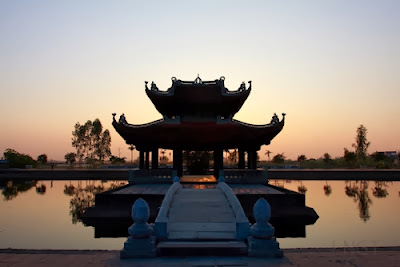
The outer rampart consists of a half - moon shaped lake with a floating pavilion and houses of Van Chi built in 2002 and Vo Chi built in 2005. Both houses share similarities in architectural layouts - Tien Duong (front) and Hau Cung (back) houses, ceremonial house, storehouse and guesthouse. The lake and floating pavilion is used to serve as a place for the former mandarins to watch water puppet show. Queen Temple (Den Vua Ba) which is dedicated to mothers-queen lies in the outer. Many valuable ancient objects and important historical documents are preserved in Do Temple. In particular, there is an old stele with the writing of Phung Khac Khoan, the winner of a feudal literature contest in 1602.
Do Temple contains Chieu Doi Do (the royal proclamation to change the capital city) with height of 4.5m and length of 10m. It consists of 214 Chinese characters made from pottery and adapted from Chieu Doi Do of King Ly Thai To. This work is to celebrate the 1000th birthday of Thang Long - Ha Noi. Besides, Dinh Bang Ward has some other relics such as Rong (dragon) Temple in Long Vi Hamlet, dedicated to Ly Chieu Hoang, the last king of the Ly Dynasty; Tho Lang Thien Duc (Thien Duc royal tombs) in Cao Lam Hamlet where Ly Kings' tombs are placed; Co Phap Pagoda, also called Dan Pagoda, nestling amidst Chua Dan Street and relating the legend said that Queen Mother Pham Thi gave birth to Ly Cong Uan in this pagoda on March 8, 974; and Kim Dai Pagoda, also called Luc To Pagoda in Xuan Dai Hamlet, where Ly Cong Uan used to stay to serve as a Buddhist novice.
 
Dong Ho Painting Village - Bac Ninh Province Tourist Guides
Located by the Duong River (Thuan Thanh District), Dong Ho is a nice village that specializes in making folk paintings.
Dong Ho's craft of making folk paintings has long come into existence. In the past, the villagers just made paintings before Tet Holiday (Lunar New Year's Day). Nowadays, tourists can buy paintings at any time in the year. Dong Ho villagers do not draw but use wood engravings to print paintings. A fine engraving requires dexterity of the pattern drawer. The painting must be printed on fine do papers. Colors for painting are obtained from such natural materials as half-baked bricks and ashes of some kinds of leaves and roots. In order to make the glittering background for do papers, the artisan burns scallop shells to a kind of powder which is refined and mixed with resin; and then the mixture is pasted on the paper sheet which will be used for painting.
Dong Ho's paintings have conventional layouts, contents, and colors. For a large part, the paintings reflex wishes for peace, happiness, and prosperity. Some paintings focus on animals such as cows, pigs, dogs, and cats, which are familiar with farming life. Particularly, such topics as "catching coconuts", "mice's wedding", and "jealousy" always attract tourists at home and abroad. Nowadays, Dong Ho villagers also make votive objects for traditional rituals.
Every Tet Festival, a paintings market is held at the Dong Ho Communal House, drawing visitors in quantity. Also at the communal house, a contest of votive objects is held from late 14th to 18th day of the third lunar month. These are two unique cultural events of Dong Ho Village.
 

Dinh Bang Communal House
Dinh Bang Communal House, located in Dinh Bang Village, Tu Son Town, 20km from Ha Noi, is very famous in the North of the country. Its construction started in 1700 and ended in 1736. The house is a place of worship for three tutelary spirits: Cao Son Dai Vuong, God of land, Thuy Ba Dai Vuong, God of water, and Bach Le Dai Vuong, God of harvest. The main part of the communal house is rectangular, 20m long and 14m wide, and it is divided into seven rooms. It is very imposing Duc to its large roof and its 60 or so ironwood pillars, which range in diameter from 55 to 65cm. The design of the components is very complex and the structure is very sturdy. There is a panel inscribed with Chinese characters that is read in Vietnamese as Bat Ma Quan Phi, which means Eight Running Horses.
To get to Dinh Bang Village from Ha Noi, cross the Red River on the Chuong Duong Bridge and then take National Highway 1Afor nearly 20km. Dinh Bang, which is rich in sites of historical interest, is one of the 20 traditional handicraft villages of Bac Ninh. In Dinh Bang, people are experts in lacquer-ware. Moreover, almost everyone in the village sings quan ho. People of all ages and of both genders express their feelings through lyrics that bear a deep national character.

Pagodas as Tourist Destinations in Bac Ninh Province

1/ Dau Pagoda - Bac Ninh Province Tourist Guides
Dau Pagoda is located in Thanh Khuong Commune, Thuan Thanh District, 30km from Ha Noi. It was built at the beginning of the 3rd century, in a region that later became a centre for Buddhism. In Buddha's main sanctuary, there is a large statue of the female genie Phap Van, seated on a lotus flower, which is o why the pagoda is also called Phap Van Pagoda.
In the pagoda yard is a famous tower built in the 6th century. This tower was built as a protection against evil winds.

2/ But Thap Pagoda
But Thap Pagoda is located west of But Thap Village, in Dinh To Commune, Thuan Thanh District. But Thap Pagoda is one of the most famous pagodas in Viet Nam. Inside, there are various valuable ancient objects and statues, which are considered to be Vietnamese masterpieces of 17th century wood carving. Among them are the Tay Thien Dong Do Lich Dai To statue and the Kuanin statue with one thousand eyes and one thousand arms, made in 1656 and symbolizing the reverence of both religion and beauty.


But Thap Pagoda Vietnam tourist
Main part of But Thap Pagodas

3/ Phat Tich Pagoda
This pagoda was built between the 7th and the 10th centuries by the mountainside of Phat Tich in Phat Tich Commune, Tien Du District.
Under the Ly Dynasty, the pagoda underwent a large - scale restoration. In 1057, King Ly Thanh Tong ordered the building of a tower for valuables and he had a gold-inlaid statue cast. The pagoda was heavily damaged in 1947. However, in 1991, it was reconstructed in its original design. There are some ancient relics preserved in the pagoda, such as a statue of Amitabha Buddha on a 1.87m high lotus pedestal carved out of blue stone, a tower garden, and a stone board engraved with images of musicians and dancing girls.
On September 25,2010, a giant Buddha statue shaped based on the model of Amitabha Buddha statue inaugurated on the peak of the Phat Tich Mountain. The statue, which measures 27m high and weighs 3,000 tonnes, is one of the largest stone statues in Southeast Asia and the first of its kind in Viet Nam.

                                                                                                          Bac Ninh Province Tourist Guides  

Monday, July 8, 2013

Tourist destinations nearby Hanoi

Tourist destinations nearby Hanoi


Co Loa Citadel & An Duong Vuong Temple
Co Loa Citadel is perhaps the most ancient citadel in Viet Nam. It was built by Thuc An Duong Vuong in the 3rd century BC to be the capital of Au Lac Kingdom (the name of Viet Nam at the time). It was built according to a helical design and was surrounded by three ramparts and a deep moat.
The remains of the citadel are located on the same site where archaeologists have found tens of thousands of bronze arrowheads, iron axes, and animal bones. Close to the citadel are the remains of Co Loa Communal House, a temple devoted to the cult of Princess My Chau and An Duong Vuong, a King who loved his daughter with all his heart but, lacking vigilance, left Co Loa and lost both his family and his country.
Co Loa Citadel is located 18km north of the centre of Ha Noi in Co Loa Village, Dong Anh District.
Tourist destinations nearby Hanoi
Coloa Citadel
Perfume Pagoda (Chua Huong)
This tourist destinations is situated in My Due District, approximately 70km south-west of Ha Noi. To go there, travelers must cross Ha Dong, then Van Dinh, to reach Ben Due Wharf. From there, a boat takes them for a scenic 3km ride on the Yen Vy Stream. The landscape displays high mountains, deep forests and streams that harmoniously intermingle with the rice fields.
Huong Tich Grotto is the most beautiful and famous of the grottoes in the area. It was discovered more than 2,000 years ago. When Lord Trinh Sam visited the grotto in the 18th century, he wrote five Chinese characters on the entrance in calligraphy: Nam Thien De Nhat Dong, meaning "the most beautiful grotto under the Southern skies". In the middle of the grotto is a statue of Bodhisattva Kuanin. Surrounding the statue are stalagmites resembling golden trees, silver trees, cocoons, hillocks, and a group of nine dragons.
Many Vietnamese visit the Perfume Pagoda to implore Buddha for happiness and good luck, as well as to immerse themselves in the beauties of nature. The Perfume Pagoda Festival begins after the New Year's festivities and lasts until the 3rd lunar month. During that period, between three and four hundred thousand people, from children to 60 and 70 year-old pilgrims, visit the Perfume Pagoda.

Thay and Tay Phuong Pagodas
Thay Pagoda belongs to Sai Son Village in Quoc Oai District, 25km south-west of Ha Noi. The pagoda was built on the slopes of Sai Son Mountain. Water puppet shows are held on Long Tri Lake, where a bridge with a tile roof built in 1602 remains.
As for Tay Phuong Pagoda, it was built in the 8th century and it is located on Cau Lau Mountain, about 35km south-west of Ha Noi. More than 200 stone steps must be climbed before reaching the pagoda where one can admire hundreds of large statues made of lacquered and gilded wood, featuring among the best specimens of Vietnamese traditional statuary art.
Visiting both sites by car or motorbike requires one whole day. It is best to leave Ha Noi early in the morning to go first to Thay Pagoda. After climbing the mountain, visitors stop in the grotto for lunch, which can not be purchased on site. They can go and visit Tay Phuong Pagoda in the afternoon in order to be back in Ha Noi before night.
 
Tram Gian Pagoda
Tram Gian Pagoda, also known as Tien Lu (fairy guests) Pagoda, is located in Tien Lu Village, Tien Phuong Commune, Hoai Due District, nearby Hanoi downtown.
The pagoda was built during the Ly Dynasty and has since been restored several times. There are one hundred sections in the pagoda. The three-entrance gate has eight roofs standing majestically on the top of a hundred brick steps. Many valuable relics are pre-served in the pagoda. In the upper hall, there is a rectangular pedestal. Also in the pagoda & is a statue of Tuyet Son Buddha carved out of black jack-tree wood. In the yard, stands a two-story bell tower with eight roofs built in 1693. It contains a 1.42m-wide copper bell Si cast in 1749. Surrounding the pagoda, there are old coniferous trees and solidly built towers.

Tram Pagoda
Tram Pagoda, also called the Long Tien (Dragon Fairy) Pagoda, is situated in the area of Tram Mountain in Long Chau Village, Phung Chau Commune, Chuong My District.
The pagoda was built in the year 1669, the seventh year of the reign of King Canh Tri. Despite being renovated on several occasions, the pagoda still retains its original artistic style of the 18th and 19th centuries, including its sophisticated engravings. The middle stone of the pagoda's three levels is beautifully engraved with the images of two lizards.

Dau Pagoda
Dau Pagoda with the old name Thanh Dao Tu, located at the end of Gia Phuc Village, Nguyen Trai Commune, Thuong Tin District, about 24km south of Ha Noi. The pagoda worships Phap Vu, one of the four Goddesses who are worshipped in the region.
A visit to Dau Pagoda helps visitors to see rare and precious exhibits of stone pedestals from Ly Dynasty decorated with lotus flowers. On staircases of the main hall, there are two stone dragons created during the Tran Dynasty in round bodies, winding as waves on blocks of stone. Visitors will be deeply interested in the ancient traditional architectures, the sculpture on beams, columns or panels... all depict legendary traditions: fairies on dragons, boys fighting tigers, or four sacred animals: dragon, lion, turtle and phoenix (long, ly, quy, phuong). Of particular note are the mummified bodies of two monks, Vu Khac Minh and Vu Khac Truong, who died meditating in the mid 17th century. Their bodies underwent extensive restoration by the Institute of Archaeology in 2003. This is the most special culture heritage in Dau Pagoda.

Son Tay Ancient
This tourist destination located in Son Tay Town, 42km nearby center of Ha Noi, the citadel was built in 1822 in a square shape. The wall of the citadel is constructed of laterite, an extremely strong type of stone. It has four gates, the east (Dong), the west (Tay), the front (Tien) and the back (Hau) gates, where watch guards used to stand. Surrounding the 2,000m perimeter of the citadel is a moat, which is 3m deep and 20m wide. Inside, there are four cannons standing"by the four corners. There is also the Kinh Thien Hall (a place for the king to relax during his inspection days in the locality), the villas and court hall of the provincial mandarins, and the food stocks and camps for the soldiers.
Time and war have destroyed many areas inside the ancient citadel. Nowadays, only some sections of the citadel walls, some gates and some other architectural works remain. The whole historical site is now being preserved and restored.

Thanh Chuong's Viet Palace
Located nearby Hanoi, in Day Dieu Slope, Hien Ninh Commune, Soc Son District, about 35km from Ha Noi's centre, Thanh Chuong's Viet Palace is a familiar tourist destination place for those who love to discover Vietnamese culture. This palace wears breaths of immemorial time blanketing houses, antiques and surrounding trees.
Thanh Chuong's Viet Palace was initially the home and studio of Thanh Chuong, one of the celebrated painters in contemporary Vietnamese art. Soon after its existence in 2002, Thanh Chuong's Viet Palace instantly became famous as a unique cultural preservation site, a spiritual legacy of Vietnamese art and culture. The simple paths, cottage houses, lotus ponds together with images of water rice civilization such as water ladles, rice mortars, bamboo beds and green-moss stone steps bring tourists nostalgic feelings I but are familiar and cosy.
The 10,000m2 palace has old houses belonging to many varied regions and cultures. However the highlight of the palace is a complex of statues made of stone, wood, bronze or ceramic installed and displayed in the houses and yards around the site. Moreover, tourists also have a chance to admire paintings of artist Thanh Chuong, works made by harmony of folk and contemporary, past and present.
At the palace, the tourists can also enjoy folk music performances of quan ho, folk singing and water puppet shows.
Opening hours: 9h - 17h30 (summer) and 9h - 17h (winter) from Tuesday to Sunday.
Ticket: VND30.000- 100,000 (Price of 2012)

Ba Vi Mountain and National Park
Tourist destinations nearby Hanoi
Tourist and a tree in Bavi
From Ha Noi, one can reach the Son Tay Town (42km) by following National Highway 32 (or by High-speed highway Lang -Hoa Lac) and then travelling another 16km in the direction of Suoi Hai Lake where rest houses have been built. Boats take visitors around the lake, stopping on islets where medicinal plants are grown and birds nest. Then, going east of Ba Vi Mountains, you can visit Ao Vua Fall. Looking from above, the fall makes a three-story cascade, the last of which flows into a small lake with emerald-green water. A 400m climb leads to the remainders of a summer villa built by the French in 1940. There is a road that allows visitors to reach an altitude of 1,200m where they can enjoy a night rest in a hotel under the starlit sky.
Back at the foot of the mountain, visitors can also explore the Ba Vi National Park, which covers a protected area of 7,377ha. The climate is temperate and there are 812 species of high - level flora. The park contains many rare animals such as the weasel (chon bac ma), tibetan bear (gau ngua), civet (cay van), flying squirrel (soc bay), white pheasant (ga to/ trang), etc. Aquatic plants are numerous with floating plants and green alga.
The park contains a great deal of creature representative for many types of climate ranging from hot and humid to cool and cloudy. From the peaks of some high mountains, travellers can have a broad view of Ba Vi landscape. The natural landscape of the rivers, mountains, lakes, and the stretching rice fields that harmoniously intermingle with the calm villages which look very romantic. The park is an ideal destination for those who love outdoors-adventurous activities and want to relax at weekends.

Bao Son Paradise Park
Located in An Khanh Commune, Hoai Due District, about 15km from downtown Ha Noi. Bao Son Paradise has both traditional and modern architecture. Passing the entrance gate, visitors seem to be lost into a tranquil world that is quite opposite to the crowded, bustling neighborhood outside. An old quarter with more than 20 houses covering an area of 5,000m2 represents life of Hanoians with traditional products in the late 19th and early 20th centuries.
A short distance further is a 10,000m2 complex of 15 typical traditional handicraft villages of Viet Nam. The houses in these villages dated back over 100 years ago with banyan tree, the well and village temple, all with an aim to enchant visitors. All create a peaceful rural environment of the Red River Delta in the old times.
The ecological area characterizing the enchanting land of Vietnam includes zoo, orchid garden, king area garden, butterfly garden, flower garden and underwater world.
A modern entertainment area has an imposing stage for water musical performance, laser movie shows, and dolphin and seal performances, with a capacity of 11,000 seats. In particular, there is a multi-functional entertainment quarter for people of different ages with impressive games and rides. In addition, there is a 4D movie theater having 48 rotating seats that makes the audience feel that they are in a fanciful world.
After touring around the area, visitors can relax by swimming in the cool pool, then going to the gastronomy court divided into two areas: stilt houses and old houses. This area offers specialties of all 3 regions of the country and other Asian dishes as well.
Ticket price (in 2012) to visit Bao Son Paradise is VND40.000 /adult and VND30,000/child for all days except Sunday with VND50.000 /adult and VND40.000 /child.

Dong Mo golf course and tourist site
To reach Dong Mo Tourist Site, 50km from Ha Noi, travel along National Highway 32 to the Son Tay Town and then continue for another 10km. Dong Mo includes a large 1,300ha lake that has many islands and peninsulas in it. On the 350ha King Island (also called Dam Island), located in the centre of Dong Mo, there is an eighteen-hole golf course. Pretty villas partially hidden in the woods mirrored in the transparent water of the lake.
Easily reached from Ha Noi, Dong Mo Tourist Site is an ideal place to escape from town and relax in a slow-paced environment.
 
Khoang Xanh - Suoi Tien Tourist Site
Nearby Hanoi, belong to Van Hoa Commune, Ba Vi District, about 60km from Ha Noi's centre, Khoang Xanh - Suoi Tien Tourist Site has imposing scenery with clear and beautiful Suoi Tien (fairy stream). Go along Suoi Tien, the scenery is wonderful with foaming fall creating marvellous sound. The tourist site has 3 areas, of which Suoi Tien Water Park consists of 20,000m2 wave-created lake, artificial sea, sliding lines of high speed and many attractive water games. Khoang Xanh hot spring area has indoor hot mineral water swimming-pool with area of 1,000m2, tubs for mud bath and hydropathy. In addition, Dinosaur Valley recreates 12 species of giant dinosaurs and serves strong feeling games.
Coming to Khoang Xanh - Suoi Tien, the tourists will be enjoyed many other services such as restaurant, karaoke, massage, sauna, camping fire, traditional song and dance...

Thac Da Eco-tourist Site
Thac Da Eco-tourist Site is located in Ba Vi Commune, about 60km west of Ha Noi's centre. This is an amazing rendezvous for nature lovers to come closer to nature and live in stilt houses of Muong and Thai ethnic tribes under stillness, coolness and greenness of -forests. Here is also the host for traditional performances such as quan ho, cheo and other artistic ethnic shows.
The fall splashes look like a giant, white and silver carpet flowing in the forest. Next to the waterfall, visitors can relax at a swimming pool, fishing pond, sports playground or a fruit orchard and enjoy indigenous specialties in small restaurants.

Tu Tram Mountains
Tu Tram Mountains are in Long Chau Village, Phung Chau Commune, Chuong My District, 20km from Ha Noi by National Highway 6.
Tu Tram is a valuable gift of nature, a chain of limestone mountains, that appear among the fertile fields creating a beautiful scenery. In 1516, under the reign of King Le Chieu Tong, a royal stop-over place was built here. The King then ordered rivers and streams to be arranged to make the area a beauty-spot for his leisure time. Nowadays, some architectural ruins, such as Long Tien Pagoda, Quan Am (Bodhisattva) Pagoda, Vo Vi Pagoda, Ba Lang Pagoda, Cao Son Temple and Mother Temple still remain around Tu Tram Mountains.
Visitors also have the opportunity to explore Long Tien Cave. The mouth of the cave is not very big, but its inner space is very large and high. Hanging down from the ceiling and the wall of the cave are stalactites of various shapes. Inside the cave, you will also find a pagoda containing a statue of Amitiyus Buddha meditating on a lotus pedestal with an honest and sympathetic smile on his face. The sophisticated carving makes the statue almost look alive. On the ceiling and wall over the cave gate, visitors can find the handwriting of talented scholars from the late years of the Le Dynasty to the early years of the Nguyen Dynasty. There are nearly 20 poems and prose passages adorning the Tu Tram Mountains.
On Trao Mountain, next to Tu Tram, is Vo Vi Pagoda, which was built in 968, and which has retained many stelae of historical and artistic value. Tu Tram Festival takes place annually on the 2nd day of the 2ndlunar month and attracts many visitors and pilgrims.

Quan Son Lake
Quan Son Lake is located in My Due District, approximately 40km from Ha Dong. The lake stretches from Tuy Lai Village, passing through Hong Son to the Cau Dam spillway. Water runs through mountain falls making the lake surface larger and more beautiful. The small peaks jutting up from the lake are bird habitats. Surrounded by mountains and clouds, the lake is quiet, cool and romantic.
Visitors can go boating and fishing and enjoy various local fish specialties. Boats can be rented at a reasonable price. 
Tourist destinations nearby Hanoi

Thursday, July 4, 2013

Tourist guides for Ba Ria - Vung Tau

Highlights: Vung Tau beaches, Long Hai Beach, Binh Chau Hot Spring, Con Dao Island and National Park.
Ba Ria-Vung Tau is 116km from Ho Chi Minh City, just below Dong Nai Province and next to the East Sea. Its terrain includes mountains, hills, beaches, plains and sand dunes stretching along a 100km of coastline. The climate is divided into two main seasons. The rainy season from April to October, and the dry season from November to March. The average annual temperature is a balmy 27°C (80.6°F).
Due to the harmonious combination of the sea, mountains and beaches, this Is a grout tourist area. The friendly town of Vung Tau (known as Cap Saint-Jacques during the French colonial period) attracts many people from Ho Chi Minh City, who come here to spend the weekend or some holiday. Just off the coast is the Con Lon Archipelago, including Con Dao Island, which is endowed with a national forest, beautiful beaches and rare and precious sea products. This area is also well known for its industrial petroleum and gas development. The handicraft products are also developing a name for the province, with ornaments made of snail shells, coral and turtle shells. Popular festivals also characterize this animated and lively sea area.

Tourist Attractions

Giant Jesus Statue
This enormous 32m figure of Jesus gazing across the East Sea with outstretched arms is located at the southern end of Nho Mountain (Small Mountain). Built in 1972 and was completed in 1994, this Giant Jesus rests on a 10m-high platform. The interior of the statue is hollow and contains a spiral staircase of 133 steps, ascending from the foot of the statue to its neck. The two shoulders of the figure are balconies, each able to accommodate up to six people, which offer a splendid view of the surrounding landscape.
Tourist guides for Vung Tau
View from the Jesus Statue
Bach Dinh (White Villa)
The construction of Bach Dinh started in 1898, and was completed in 1916. It was done according to late 19th century French influence, and its facade is decorated with ancient Greek designs. Located on Large Mountain, Bach Dinh was used as a rest house for French Governor Paul Doumer.

Vung Tau Lighthouse
Vung Tau Lighthouse was built in 1907, at an altitude of 170m, on the peak of Small Mountain. The lighthouse can project light as far as 35 miles and contains a telescope to observe and direct boats and ships. From the lighthouse, one can enjoy a view of Vung Tau as far as Can Gio Port and Ba Ria.


Temples And Pagoda in Vung Tau

Quan The Am Bo Tat Pagoda (Avalokitecvara Pagoda)

Quan The Am Bo Tat Pagoda was built in 1976, near Large Mountain, 500m from Mulberry Beach (Bai Dau). In the middle of this small pagoda, there is a white statue of Avalokitecvara standing on a lotus-shaped platform. The statue is made of reinforced concrete in the shape of a woman looking towards the sea and holding a holy water urn in her hands.

Linh Son Co Tu (Linh Son Pagoda)
Linh Son Pagoda, which is a small pagoda on Hoang Hoa Tham Street, is the oldest pagoda in Vung Tau. In the main sanctuary, there is a Statue of Buddha made of stone and gilded with gold. The statue is cleverly sculpted such that it portrays the lively benevolence of Buddha.

Thich Ca Phat Dai (Sakyamuni Pagoda)
Thich Ca Phat Dai is a large pagoda that is located at 25 Tran Phu Street in Vung Tau, 3km from the city centre. This pagoda was built in 1961 and was completed in 1963, on a 6ha area on the eastern slope of Large Mountain. The beauty of the pagoda resides in the union of the religious architecture with the landscape. The 19m Bat Giac Tower (Octagonal Tower) and the Sakyamuni Statue are not to be missed. Both shining of a sparkling white, there were erected half-way up the mountain slope. The pagoda is open from 6am to 6pm.

Niet Ban Tinh Xa Pagoda
Construction of Niet Ban Tinh Xa started in 1009 and was completed in 1974. The pagoda faces the sea son on the western side of Small (Nho) Mountain and houses a giant statue of a reclining Buddha made of reinforced concrete and covered with marble (from the Marble Mountains in Da Nang). Niet Ban Tinh Xa is famous for its 5,000kg bronze bell.

Beaches in Vung Tau


Back Beach (Thuy Van Beach or Bai Sau)
Located southeast of Vung Tau, Back Beach is a large and beautiful beach. There are many accommodations and services in the area. The complex of hotels on Thuy Van Street has rooms available to suit all budgets. There are also restaurants and parking areas, as well as lifeguards patrolling the beach.

Front Beach (Tam Duong - Bai Truoc)
Front Beach is located in the centre of Vung Tau, along the Quang Trung Str., where stand numerous luxurious hotels: Palace, Rex, Hong River, Huong River, Royal, etc. From Bai Truoc, the new Ha Long St. leads to Pineapple Beach (Bai Dua). Back Beach (Thuy Van Beach) can be reached by following Hoang Hoa Tham St.

Pineapple Beach (Bai Dua)
Pineapple Beach is situated between Front Beach and Back Beach, near Small (Nho) Mountain and Nghinh Phong Cape. There used to be numerous wild pineapples that grew on the rocky shore, which is why the beach is called Pineapple (Dua) Beach. The waves here are small and safe.

Nghinh Phong Beach (O Quan)
Nghinh Phong, meaning "receiving the wind" in Vietnamese, is situated at the extreme south of Vung Tau, near Pineapple Beach. The beach is narrow, the water is transparent with continuous waves and wind, and it is bordered by high rocky cliffs (Nghinh Phong Cape). This is an excellent location for surfing.

Mulberry Beach (Bai Dau)
Mulberry Beach lies at the foot of Big Mountain, 3km from Front Beach. The beach is narrow and its waves are very small. This is a popular beach with those who appreciate its calmness, cleanness, and beauty.

Long Hai Beach
Vung Tau Beaches Long Hai
Long Hai Beach

Long Hai Beach runs several kilometres along the Chau Long and Chau Vien Mountains. At a few spots, the mountains seem to merge into the sea creating magnificent stone beaches. Along the coast, there are several kilometres of cherry orchards. During the blossom season, the scenery is fantastic. This beach is a favourite for many people who find it quieter than those in Vung Tau. Long Hai Beach is comparable in beauty with those in Nha Trang. It will soon become a vacation resort offering activities such as swimming, surfing, boating, hiking and mountain climbing. A new resort was built, called Anoasis Beach Resort. It is considered the best resort in Southern Viet Nam. It is located 2km from small town of Long Hai. Long Hai Beach is 120km south of Ho Chi Minh City, 40km northeast of Vung Tau City, 15km southeast of Ba Ria Town.

Lady Islet (Hon Ba)
Hon Ba is located approximately 200m from Smalll Mountain. When the tide is low, it is possible to walk to this tiny island. On the 1st and 15th of each lunar month, people go to lliti Monti und burn Incense for luck. Hon Ba In n lovely scenic spot in Vung Tau. 
Tourist guides for Ba Ria - Vung Tau
Vung Tau Tourist attractions
Beaches in Vung Tau
 

Tuesday, June 18, 2013

Tourist Guides For Ninh Binh, Vietnam

Ninh Binh Province has been favoured by nature, as the Day River, the Van Sang River, the Non Nuoc and Canh Dieu Mountains, etc., are all located in the region. The harmonious mingling of the mountains, plains, rivers, and sea has created strangely attractive landscapes.
In this province, Hoa Lu was chosen as the capital of Dai Viet in the 10"1 century. Besides, the Tam Diep Mountains were the location of King Quang Trung's headquarters on his way to fight Chinese invaders.

Hoa Lu Ancient Capital
In 968, Dinh Bo Linh ascended to the throne and took the name of King Dinh Tien Hoang. The country was then called Dai Co Viet and Hoa Lu was its capital for 41 years (968-1009). In 1010, Ly Thai To moved the capital from Hoa Lu to Thang Long.
Hoa Lu is 13km from Ninh Binh City, near the village of Truong Yen. Tourists visiting Hoa Lu can see two temples located 500m apart from each other on the ground of the ancient palaces. One is dedicated to King Dinh Tien Hoang and the other to King Le Dai Hanh. On the 10th day of the 3rd lunar month, a great number of pilgrims come to Hoa Lu to pay tribute to Kings Dinh and Le.
Ninh Binh Travel guides
Hoa Lu Ancient Capital
King Dinh and Le Temples
Dinh Temple is located in Truong Yen Thuong Village, Hoa Lu District. It was built in the shape of a Chinese character.
After the first entrance, called Ngo Mon, there is a royal stone bed with Nghe (mythical animals of the old times) standing on both sides. Outside the temple, is Khai Thanh sanctuary dedicated to the parents of King Dinh.
The temple is divided in three sanctuaries: Bai Duong, for the community, Thien Huong, in honour of mandarins, and Chinh Cung, where the statue of Dinh Tien Hoang is located. On the left is the statue of his eldest son Dinh Lien. On the right are statues of Dinh Hang Lang and Dinh Toan. On each side of the altar, there is a stone placed near royal beds.
Le Temple is situated in Truong Yen Ha Village, Hoa Lu District, 500m from Dinh Temple. In terms of architectural design, Le Temple is very similar to Dinh Temple, but smaller. It also consists of three parts: Bai Duong, used for the community, Thien Huong, in memory of the royal mandarins of the King Le, and the altar in memory of the King. The statue of Le Hoan is at the centre,on the left is the statue of Queen Duong Van Nga and on the right is that of Le Ngoa Trieu, his fifth son and third king of the Pre Le Dynasty.

Phat Diem Cathedral
Phat Diem Cathedral complex is located in Luu Phuong Commune, Kim Son District, 130km south of Ha Noi, 29km from Ninh Binh City. It was built between 1875 and 1899. It is an ensemble of constructions in the Oriental architectural style. They are divided into two sections: the worshiping section and the section for residence and teaching of religious doctrines.
From the entrance a path leads us to a rectangular lake. In the centre of the lake is an island with a statue of Christ. Next comes a huge three-level square pavilion, 24m long, 17m wide and 25m high, built of stepping-stones. Its arches are made of sophisticated overlapped stones. Both sides of the four walls around the pavilion are decorated with embossments, many of which show the Christ shouldering the cross, and other gods. On the second layer of the pavilion there is a drum and on the 3rd layer there is a bell cast in 1890, 1.4m high, 1.1m in diameter and nearly two tons in weight. The pavilion consists of five arches; each arch stands in each of the pavilion's four corners and the highest arch is on the 3rd layer. The roofs of these five arches are not as high as those found in other cathedrals but typically curvy and they resemble the arches of ancient Vietnamese temples and pagodas.
The main cathedral was built in 1891. It has five delicately carved entrances and three high curvy roof towers. It is 74m long, 21m wide and 15m high, having four roofs and six rows of ironwood pillars, the two pillars in the middle are 11m high and 2.35m in circumference. The main altar is a stepping stone 3m long, 0.9m wide, 0.8m high and about 20 tons in weight. Its three facades and two sides are carved with flower decorations.
Lying parallel to the main cathedral are four smaller ones, each different from others in style. At the end of the main cathedral to the north are three man-made caves, the biggest of which is Lo Due natural-looking cave in the northeast. At the far end, to the northwest is the Stone Cathedral - the place for worshiping the heart of Virgin Maria. It earns such name because all of its columns, beams, walls and window bars are stonework. Its inner wall is made of marble with embossments of stone lions and phonics. It was built in 1889, measuring 15m long and 9m wide.
Phat Diem Cathedral is a solemn and interesting architectural complex, reflecting the skilful and excellent stone carving art of the Vietnamese workers. This place is attracting many visitors.
Trang An Eco-tourism Complex
A scenic watery area covering 2,168ha, the Trang An Eco-tourism Complex is located in the vicinity of Hoa Lu and Gia Vien districts, and Ninh Binh City. From Ha Noi, visitors travel 90km on highway 1A southward to the Ninh Binh Television Station (in Ninh Binh City); turn right and the Trang An Eco-tourism complex is reached by traveling for 3km.
According to incomplete statistics, the Trang a An eco-tourism complex boasts 12 historic relics and numerous grottoes and caves, including a system of 48 aquatic caves and caverns with a total length of 12,226m and springs, streams and rivers serving as portals into limestone mountain ranges. Geologists have figured out that Trang An is where sea waters overwhelmed. The process of geological evolution 200 years ago had created a subsurface system of interconnected caverns, caves and streams in the limestone mountains. The size and shape of caves has made up the maze-like formations to defend the Hoa Lu Ancient Capital. Vestiges found at the foot of the limestone mountain have provided proofs of the existence of sea here long ago. That's why the Hoa Lu limestone mountain area is also called "inland Ha Long Bay".
In Trang An, boat trips are offered to enable visitors to explore the breathtaking beauty of the maze-like aquatic cave system, which is famed as the "sole aquatic cave system" in Viet Nam's northern delta region. The caves, sculpted into an unlimited variety of geological formations, each reaching from dozens of meters to hundreds of metres in length, are connected by 31 "thung" (lakes). Distinguished from one to the other by its own unique beauty or a fairy tale attached, each bears its own name, such as Sang (Light) Cave, Toi (Dark) Cave, Ba Giot (three-drop) Cave, Nau Ruou (Brewing wine) Cave, Dia Linh Cave, Ao Trai Cave, Si Cave, Sinh Cave and others.
The very rich fauna and flora that has survived the time adds more weight to the spectacular beauty of the Trang An Eco-tourism Complex. Here, it is home to large trees, such as cho chi (Parashorea chinensis), and nghien (Burretiodendron hsienmu), and rare species of animals, like phuong hoang dat (Buceros bicornis) and vuon yem trang (Nomascus leucogenys). Here, traces of pre-historic peo-ro pie believed to inhabit here 5,000-30,000 years ago have been found in Boi and Trong caves and on archaeological sites on Cho Cave limestone mountain and Hay limestone mount. Ancient pottery wares and objects used for making alcohol had been found in Nau Ruou Cave.

Tam Coc Caves
Tarn Coc has been called "inland Ha Long Bay". Tam Coc means three tunnel caves, entailing Ca Cave, Hai Cave and Ba Cave. Tam Coc can also be called Tam Thuy Dong as the Ngo Dong River wends through all three tunnel caves that have bored through the limestone hills.
The enchanting world of Tam Coc can only be entered from the Van Lam Wharf. Here, visitors travel by rowboat on the Ngo Dong River about 3km to visit all three caves. The first is Ca Cave which is 127m long and 20m wide. The next is Hai Cave of 60m long and 18m wide which is reached by traveling about 1 km from Ca Cave. And the last is Ba Cave with 50m long and 18m wide located near Hai Cave These caves are adorned with beautiful stalactites and stalagmites of different shapes and colours that sparkle like gem-stones.
This is very peaceful and scenic trip while admiring a magnificent view of the river, mountain, and caves. Worth visiting Tam Coc takes place in March, or the end of May and early June. In March, the Ngo Dong River peacefully blends with green rice fields and cotton trees having red flowers in the spring. At the end of May and early June, the Ngo Dong River goes together with fields of ripe rice covered the yellow colour. During the time, boats carrying tourists in and out of Tam Coc are mingled with the locals transporting harvested rice.
Tam Coc Cave Vietnam
On The Way to Tam Coc Caves
Fairy Cave (Dong Tien)
Fairy Cave, also known as Moc Cave (Dong Moc), is located in Dam Khe Village, Ninh Hai Commune. The cave is about 1 km from Bich Dong and can be reached by boat or by foot.
The grotto is divided into three big and deep caves that are reached via an uneven narrow path. The cave ceiling is decorated with rainbow coloured stalactites, some of which reach down from the ceiling to the floor, similar to the roots of an old Banyan-tree. Some stalactites bear names related to their appearance, such as Silver Tree, Bouddha, Fairy, Elephant, Tiger, etc. Bathed with supernatural light, the cave looks like a splendid palace from a fairy tale.

Bich Dong Cave
Bich Dong Cave is in the Ngu Nhac Son Mountains, in Dam Khe Village, Ninh Hai Quarter, Hoa Lu District.
In 1773, Mr. Nguyen Nghiem (the father of the great writer Nguyen Du) visited this cave. After viewing the whole scenery of the mountains, waterways, fields, and sky covered in green mist, he gave the cave a very beautiful and romantic name, Bich Dong (which literally means "Green Pearl Cave"). Bich Dong Cave is said to be the second most beautiful cave in Viet Nam.
Dich Long
Cave Dich Long Cave was found in 1739 in Gia Thanh Commune, Gia Vien District. It is as large as a ten-room house. Because, there is a stone inside that looks like a Buddha statue, a Buddhist altar was built and, in 1740, the cave became a Buddhist Pagoda. It shelters statues of Buddha, Arhats and a guarding colossus standing on stone pedestals. In particular, there are two beautiful statues carved from one block of blue stone. The cave has three sub-caves that are linked together; namely, the caves of Buddha, Darkness, and Brightness.
The Dich Long Cave gives visitors the feeling of being lost in a stone world of stalactites. There are stalactites of various shapes, such as a drinking elephant, a kneeling elephant, a reclining tiger, a dancing phoenix,drinking dragon, and an ape with a baby on its back. Every wall and ceiling in the grotto is a work of art created by nature and time.
The colours of the stalactites in the cave change with the brightness of the sun. Early in the morning they have a pink colour, which turns into twinkling crystal in the midday, and then to red at sunset. It is as if there were ways to heaven and to hell from the cave.
The shadowy beauty of the cave has been complimented in many poems. King Minh Mang himself called it Nam thien de tam dong (the third most beautiful cave in Viet Nam).
 
Van Long Wetland Nature Reserve
Travel Guides to Vietnam
Van Long Wetland Nature Reserve
Van Long Wetland Nature Reserve is located in seven communes of Gia Vien District, about 90km south of Ha Noi. Covering an area of nearly 3,000ha, Van Long is the largest wetland nature reserve in Northern Viet Nam with canals, lakes and streams wend through an island-like landscape of karst limestone mountains. Start from Ha Noi and go along Highway 1A southwards for about two hours, tourists will reach the T-junction of Gian Khau. Turn right and go 7km further; they will arrive at Van Long Wetland Nature Reserve.
Van Long is home to a wide variety of flora and fauna, including 457 species of plants, of which 8 species are listed in the Viet Nam's Red Book; 39 species of mammals, of which 12 species are listed in the Viet Nam's Red Book as well. Lucky tourists can spot the Delacour's Langur Trachypithecus here in its natural environment. This species occurs only in a small area of Northern Vietnam and nowhere else in the world today.
Van Long is also known for many beautiful caves and grottoes, such as the Ca, Rua, Chanh and Bong caves. Among them Ca (Fish) Grotto at the foot of Hoang Quyen Mount is considered the most beautiful. This grotto, 250m long and half submerged, is the habitat of many species of fish, such as the catfish, anabas and black fish. Besides, there are hundreds of mountains, such as the Meo Cao, Nghien, Voi Dung, Mo Coi, Horn Sach, Da Ban and Co Tien.
From Van Long Wharf where hundreds of boats anchor close to one another, the tourists can take a ride on a boat to discover the beauty of Van Long Wetland Nature Reserve. In the rainy season, the water flows look like silk bands stretching between rows of clumped grass. The water surface is dotted with wild flowers of different colours. In addition, the tourists can make a tour around the Van Long Village on ox carts to learn about the daily activities of the rural people and buy the local products.

Van Trinh Grotto
Van Trinh located in Thuong Hoa Commune, Nho Quan District is one of the dozen of grottoes in the wetland of Van Long.
The grotto is deep inside a 100 meter-high mountain. The entrance of the grotto is approximately 40m from the foot. A narrow path leads to the main grotto with area of 4,000m2 that is as magnificent as a castle with numerous stone sculptures in different shapes and sizes. Natural statues of monks, animals, flowers on the cliffs, ceiling and floor
look so lively. They seemed to be petrified by magic. In addition, wells with clean and cold water in the grotto also bring visitors pleasant feelings.
Deep inside the grotto is a small hold with beautiful stalagmites that look like bald cypresses. Sunlight shines through an opening on the ceiling, creating fanciful scenery.
Please come to Van Trinh to discover the secrets of nature and enjoy fresh air of the countryside.

Kenh Ga Hot Water Stream
The Kenh Ga Hot Water Stream is in Kenh Ga Village, Gia Thinh Commune, Gia Vien District. A boat takes the visitors up to the stream among the mountains and the rice fields. Although the fragrant stream has existed for a long time, it was only first studied and exploited by the French in 1940. The mineral water here is of extremely high quality and contains chloride-natrium, chloride-kalium, calcium, and magnesium chloride. The water is clear and has a stable temperature of 53 degrees Celsius with a source capacity of 5,000 cubic meters per hour. Ninh Binh is lucky to have this natural hot water stream used for relaxation and self-treatment.
Kenh Ga Hot Mineral Water is now being processed and packaged for sale.

Saturday, June 1, 2013

Temples And Pagodas in Hanoi

Van Mieu - Quoc Tu Giam
Van Mieu - Quoc Tu Giam is a famous historical and cultural relic consisting of the Temple of Literature and Viet Nam's first university. The Temple of Literature was built in 1070 in honour of Confucius, his followers, and Chu Van An, a moral figure in Vietnamese education.
Quoc Tu Giam, or Viet Nam's first university, was built in 1076. It was the first educational school for royal family members, and it was later opened to talented students. Throughout its more than 700 years of activity, thousands of Vietnamese scholars graduated from this university. In 1482, Emperor Le Thanh Tong ordered the erection of steles with inscriptions of the names, places of birth, and achievements of the graduates who had taken examinations since 1442 to 1779. Especially, 82 stone steles at Van Mieu have been recognised as World Documentary Heritage by UNESCO in March 2010.
In 1483 Quoc Tu Giam was changed into Thai Hoc Vien (Higher Educational Institute). After decades of war and natural disasters, the former construction was completely destroyed.
In preparation for the celebration of the 1000th anniversary of Thang Long (present day Ha Noi) another construction has been built following the model of the previous Thai Hoc Vien on the same ground. The work was started on July 13, 1999 and completed on October 10,2000, the day of 46th anniversary of Hanoi's liberation. With area of 1,530m2, the work includes the front hall, the back sanctuary, lean-toss on the left and on the right, the courtyard, and subsidiary structures. On March 11, 2003, Ha Noi People's Committee had statues of four cultural celebrities begun to cast. They are King Ly Thanh Tong, King Ly Nhan Tong, King Le Thanh Tong and Chu Van An who founded Van Mieu -Quoc Tu Giam and developed Viet Nam's education.
This site preserves historical vestiges of a 1,000-year-old civilization such as statues of Confucius and his disciples (Yan Hui, Zengshen, Zisi, Mencius), and ancient constructions such as Khue Van Pavilion, and Worshiping Hall.
Van Mieu - Quoc Tu Giam is located on Van Mieu Street, 2km west of Hoan Kiem Lake. It is open Tuesday to Sunday from 8am to 11,30am and 1.30pm to 5pm.
Pagodas & Temples in Hanoi
Quoc Tu Giam - The Vietnam first University
Tran Quoc Pagoda
Tran Quoc Pagoda, located on an islet in West Lake of Hanoi, is the one of the oldest pagodas in Hanoi and Vietnam also; its construction started in 541. Standing at one end of Thanh Nien Road, one can see the towers of the pagoda rising above the lake's surface. Inside, there is a precious statue of Sakyamuni Buddha entering Nirvana, which is a masterpiece of Vietnamese sculptural art. A stele dating from 1639 tells the story of this pagoda. It is open daily.

One Pillar Pagoda
The original name of the One Pillar Pagoda was Dien Huu Pagoda, which literally means "long lasting happiness and good luck". The pagoda is located on Ong Ich Khiem St., in the western part of the Thang Long Citadel, and near Ho Chi Minh's Mausoleum. It was first built in 1049, during the reign of Emperor Ly Thai Tong. According to legend, ageing Emperor Ly Thai Tong, who had no children, often went to pagodas to pray to Buddha for a son. One night, he dreamed that he was granted a private audience with Buddha. Buddha, who was seated on a lotus flower in a square-shaped lotus pond on the western side of Thang Long Citadel, gave the king a baby boy. Months later, when the queen gave birth to a male child, the Emperor ordered the construction of a pagoda supported by only one pillar to resemble the lotus seat of his dream in the honour of Buddha. The pagoda is open for tourists daily from 8am to 5pm. Entrance is free.

Ngoc Son Temple
Hoan Kiem Lake was already considered the most beautiful lake in the city when Ngoc Son Temple was built on Ngoc (Jade) Islet, in the northern part of the lake during the 19th century. It was dedicated to Van Xuong, once considered as the brightest star in Vietnamese literary and intellectual circles, and Tran Hung Dao, the national hero who led the Vietnamese people to victory over Mongol aggressors in the 13th century.
The temple, as it is seen today, is attributed to the restoration efforts of Nguyen Van Sieu in 1865. Nguyen Van Sieu, a great Hanoian writer, had a large pen-shaped tower (Thap But) built at the entrance of the temple. On the upper part of the tower are three Chinese characters, Ta Thanh Thien, which mean "to write on the blue sky is to imply the height of a genuine and righteous person's strength and will.
The temple is open daily from 8am to 5pm.

Quan Su Pagoda
Quan Su Pagoda, built in the 17th century, is located at 73 Quan Su Street. The Northern Buddhist Association chose Quan Su Pagoda as its meeting hall in 1934. In 1942, the pagoda was restored to its actual state, and since 1958, the Vietnam Buddhist Association has had its head office at the pagoda.
The pagoda opens daily from 7.30am to 11.30am and 1.30pm to 5.30 pm.

Quan Thanh Temple
The three ancient Chinese characters at the top of the entrance of Quan Thanh Temple read "Tran Vu Quan", which means that the temple is dedicated to Huyen Thien Tran Vu, the God who guarded and administered the north of the country. Saint Tran Vu was both a Vietnamese legendary character (who assisted King An Duong Vuong in chasing away ghosts during the construction of Co Loa Citadel) and a Chinese legendary character (who guarded and administered the North).
Quan Thanh Temple was built during the reign of Emperor Ly Thai To (1009-1028). Special attention should be paid to the black bronze statue of Saint Tran Vu, nearly 4 m in height and 4 tons in weight, was cast in 1677 located in the main hall. Also noticeable, a 1.5m high ancient bronze bell hangs at the top of the three-gate entrance. In the temple, a small black bronze statue of Old Trong, the chief artisan of the bronze casting team who made the bell and the giant statue of Saint Tran Vu. To commemorate the great contributions of their teacher, Old Trong's students cast his statue and placed it in the temple so that future generations would remember him.
This temple is located at the southern end of Duong Thanh Nien (Youth Road) of Hanoi, near the intersection of Quan Thanh Str., and Duong Thanh Nien, 2km west of Hoan Kiem Lake. It is open daily.

Hai Ba Trung Temple
This temple of Hanoi is also called Dong Nhan Temple because it is located in Dong Nhan Ward in Hai Ba Trung District, 2km south of Hoan Kiem Lake. The temple was built in 1142, under the reign of Emperor Ly Anh Tong and was dedicated to the Trung Sisters, Trung Trac and Trung Nhi. Two statues made of clay are located at the inner sanctum of the temple. They are surrounded by statues of the 12 female generals who followed the two sisters in leading their army to defeat their aggressors. From the 3rd to 6th days of the 2nd lunar month, there is a grand festival at the temple to commemorate the two national heroines.

Kim Lien Pagoda
Hanoi Pagoda
Kim Lien Pagoda
Kim Lien Pagoda was originally built on Nghi Tam peninsula, on the bank of West Lake. Today it is located in Quang An Ward, Tay Ho District, Ha Noi. According to legend, during the 12th century (1128-1138), Princess Tu Hoa, daughter of King Ly Than Tong, led her royal representatives to this area where they cultivated mulberries and reared silkworms. The pagoda was later built in 1631. Formerly, it had the name Dai Bi, Dong Long, and Tu Hoa. In 1771 Lord Trinh restored the pagoda and changed its name to Kim Lien (Golden Lotus) part of the former Tu Hoa Palace of the Ly Dynasty.
Kim Lien is composed of three pavilions, each of which has 2 roof layers and the appearance of being slightly curved and supple. Apart from its nice disposition, the pagoda has a gate of sophisticated and intricate architecture.
The origin architecture and decoration together with the location of Kim Lien Pagoda gives visitors an opportunity to enjoy tranquility and solitude. It is open daily.

Tay Ho Temple
Tay Ho was an ancient village of Thang Long, located to the east of West Lake. At the entrance of the village, there is a temple to worship Mother Lieu Hanh, who had an exquisite talent for playing music, singing, and writing poetry. Mother Lieu Hanh was so kind that she was raised as Thanh Mau (Saint Mother). Every year, on the 15th day of the 1st lunar month, many people come to this temple of Hanoi, not only to worship Thanh Mau in the hope that she will offer them good things and good luck, but also to admire the beautiful landscape of the capital city. 
Temple And Pagoda in Hanoi

Thursday, May 16, 2013

Ngu Hanh Son - Danang, Vietnam

Like Phong Nha, the Marble Mountains in Da Nang played an important role during the War of Resistance Against the United States. Some of the caves, which were only afew kilometers from major U.S. bases, were used as hospitals for revolutionary troops.
where to go in Danang
Ngu Hanh Son
The travel destination of Ngu Hanh Son, about eleven kilometers southeast of central Da Nang, is a complex of six rock formations near the white sands of Non Nuoc Beach on the Eastern Sea. King Gia Long (reign: l802-l820) gave the area its name. ''Ngu Hanh'' means ''five basic elements'' and ''mountains''. Each of the six formations is accorded a basic element according to Eastern philosophy. Thuy Sơn in the north represents water; Moc Son in the east, wood; Kim Sơn, metal; Tho Son in the centre, earth, Hoa Son in the south represents fire and has two smaller hills, Yin Fire and Yang Fire. Each mountain at Ngu Hanh has marble of a different colour. Thuy Son is pink, Moc Son is white, and Kim Son and Hoa Son are a mixture of black and white. This variety makes Ngu Hanh Son a valuable source of marble for local artisans.

Thuy Son in the north of the Ngu Hanh Range contains caves such as Tang Chon, Linh Nham, Van Son, and Huyen Khong. Its peak, Tam Thai, is comprised of three smaller mounts. The lowest one faces east and is called Ha Thai, the middle faces south and is called Trung Thai, and the highest faces north and is named Thuong Thai. Atop Thuy Son is Tam Thai Pagoda, which was restored in l825 by King Minh Menh (rule: l820- l840) for his sister when the decided to enter a nunnery. The pagoda has been built in l630 during the Le Dynasty. Renovated again in l975, it is noted for its sophistication in architectural style, King Minh Menh is known to have rested in its northern pavilion whenever he called here.

Other traditional architecture surrounding the pagoda include Pho Đong Tower, Tu Lam Pagoda, and the Vong Giang Đai (River View Tower), from which one has an excellent view of rice fields, the Truong Giang and Cam Le Rivers, and the Truong Son Range. Close to Tam Thai Pagoda on the other side of Thuy Son is Linh ung Pagoda, which was built during the Minh Menh Dynasty and faces the sea. This pagoda was reconstructed in l970.

Tang Chon (Truth-Storing Grotto) lies behind Linh ung Pagoda. This rectangular grotto is ten meters long and seven meters wide. Daylight often shines through into the grotto chamber, enhancing its beauty.

To the right of the pagoda is Vong Hai Đai (Sea View Tower) with wide views that include Cu Lao Cham to the southeast.

Huyen Khong Cave is the most enchanting in the Ngu Hanh Mountain Range. Hidden in Thuy Son, the cave is twenty by thirty meters and reaches as high as thirty meters with five holes through which one can see the say by day and the moon by night. Trang Nghiem Pagoda is nestled inside.

Van Thong Cave, also situated in Thuy Son, is located so close to the mountain's peak that visitors can walk through the cave to reach the mountaintop. The cave is known as the ''Path to Heaven'' and ''Day to the Clouds.'' Thien Long cave projects deep under the ground and links to tunnels that, in turn, link to more caves. Tang Chon cave is hidden behind Linh ứng Pagoda in Thuy Son. The main cave, largely untouched, resembles a small valley and has a length of ten meters and a width seven meters. Sunshine beaming into the cave creates a mystical atmosphere around the shrine dedicated to a saint. Tam Thai cave was previously dedicated to three saints - Thuong Thanh, Trung Thanh, and Ha Thanh. Close to this cave is Wind Grotto, named for its year-round gusts. According to legend, fairies sat on stone stools and played chess on the stone tables in Chessboard cave.
Danang WHere to go
Statue of Buddha in a cave of Ngu Hanh Son
While Thuy Son is known for the most spectacular caves in Ngu Hanh, the other mountains also have unusual caves. Moc Son boasts Ba Trung Cave, Kim Sơn has a huge rock in the shape of Buddha, and Tho Son has ancient bricks and the Grotto of the Toad. Huyen Vi cave, behind the Linh Son Pagoda on Hoa Son Mount, has several branches and is interesting for its walls that resemble figures ff animals, plants, and flowers. A stone crocodile greets visitors at the cave's entrance. In one corner of the cave is a lake with a formation like a statue of a man fishing. Farther on is a water well that echoes like the sound of a stringed musical instrument. At the cave's end is a formationlike an earthen drum that sounds loudly when struck.

The Marble Mountains are hoe to many legends. One tells about ancient times, when a lonely old man lived in a thatch hut by the sea. One day, the usually sunny say suddenly turned dark. As a storm beat upon the shore, a mammoth crocodile heaved itself onto the sand and gave birth to a huge egg, then slowly sank back into the sea. A moment later, a golden turtle appeared, introduced itself as the Tortoise God, dug up the sand, and buried the egg. The Tortoise God entrusted the lonely old man with the job of protecting the egg.

Day after day, the egg grew bigger and bigger, occupying more and more land. Like a giang diamond, it reflected light into many colours.

One day, the old man awoke to the sound of a crackling fire, which a group of soldiers had lit. Terrified that he could no longer protect the egg, he prayed to the Tortoise God for help. At that very moment, a large crack appeared in the egg. The elderly man entered the crack, found a cave, lay down, and fell into a deep steep, unaware of the great mystical wonder that hay occurred. Later, a beautiful girl emerged from the egg. The land on which the old man slept turned into one of the marble mountains that formed from the five pieces of the broken eggshell.

For centuries, Vietnamese living near Ngu Hanh Son have been hewing marble from the mountains and song the pink, green, black, and white stone to craft pieces of art. Khoan Khoai and Hoa Khue Viltages at the foot of Ngu Hanh Sơn are the hub of this activity. There, skilled artisans carve traditional marble statues of lions and dragons and also make bracelets, ashtrays, and animal statuettes for tourists

- Mountains in Vietnam -
- Caves in Vietnam -