Like Phong Nha, the Marble Mountains in Da Nang played an important role during the War of Resistance Against the United States. Some of the caves, which were only afew kilometers from major U.S. bases, were used as hospitals for revolutionary troops.
 |
| Ngu Hanh Son |
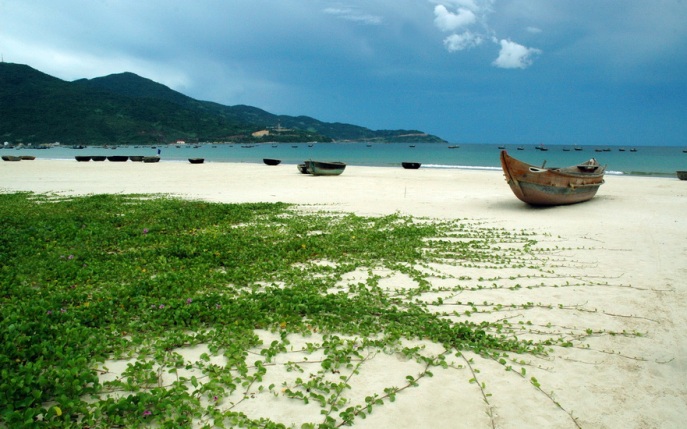
The travel destination of Ngu Hanh Son, about eleven kilometers southeast of central Da Nang, is a complex of six rock formations near the white sands of Non Nuoc Beach on the Eastern Sea. King Gia Long (reign: l802-l820) gave the area its name. ''Ngu Hanh'' means ''five basic elements'' and ''mountains''. Each of the six formations is accorded a basic element according to Eastern philosophy. Thuy Sơn in the north represents water; Moc Son in the east, wood; Kim Sơn, metal; Tho Son in the centre, earth, Hoa Son in the south represents fire and has two smaller hills, Yin Fire and Yang Fire. Each mountain at Ngu Hanh has marble of a different colour. Thuy Son is pink, Moc Son is white, and Kim Son and Hoa Son are a mixture of black and white. This variety makes Ngu Hanh Son a valuable source of marble for local artisans.
Thuy Son in the north of the Ngu Hanh Range contains caves such as Tang Chon, Linh Nham, Van Son, and Huyen Khong. Its peak, Tam Thai, is comprised of three smaller mounts. The lowest one faces east and is called Ha Thai, the middle faces south and is called Trung Thai, and the highest faces north and is named Thuong Thai. Atop Thuy Son is Tam Thai Pagoda, which was restored in l825 by King Minh Menh (rule: l820- l840) for his sister when the decided to enter a nunnery. The pagoda has been built in l630 during the Le Dynasty. Renovated again in l975, it is noted for its sophistication in architectural style, King Minh Menh is known to have rested in its northern pavilion whenever he called here.
Other traditional architecture surrounding the pagoda include Pho Đong Tower, Tu Lam Pagoda, and the Vong Giang Đai (River View Tower), from which one has an excellent view of rice fields, the Truong Giang and Cam Le Rivers, and the Truong Son Range. Close to Tam Thai Pagoda on the other side of Thuy Son is Linh ung Pagoda, which was built during the Minh Menh Dynasty and faces the sea. This pagoda was reconstructed in l970.
Tang Chon (Truth-Storing Grotto) lies behind Linh ung Pagoda. This rectangular grotto is ten meters long and seven meters wide. Daylight often shines through into the grotto chamber, enhancing its beauty.
To the right of the pagoda is Vong Hai Đai (Sea View Tower) with wide views that include Cu Lao Cham to the southeast.
Huyen Khong Cave is the most enchanting in the Ngu Hanh Mountain Range. Hidden in Thuy Son, the cave is twenty by thirty meters and reaches as high as thirty meters with five holes through which one can see the say by day and the moon by night. Trang Nghiem Pagoda is nestled inside.
Van Thong Cave, also situated in Thuy Son, is located so close to the mountain's peak that visitors can walk through the cave to reach the mountaintop. The cave is known as the ''Path to Heaven'' and ''Day to the Clouds.'' Thien Long cave projects deep under the ground and links to tunnels that, in turn, link to more caves. Tang Chon cave is hidden behind Linh ứng Pagoda in Thuy Son. The main cave, largely untouched, resembles a small valley and has a length of ten meters and a width seven meters. Sunshine beaming into the cave creates a mystical atmosphere around the shrine dedicated to a saint. Tam Thai cave was previously dedicated to three saints - Thuong Thanh, Trung Thanh, and Ha Thanh. Close to this cave is Wind Grotto, named for its year-round gusts. According to legend, fairies sat on stone stools and played chess on the stone tables in Chessboard cave.
 |
| Statue of Buddha in a cave of Ngu Hanh Son |
While Thuy Son is known for the most spectacular caves in Ngu Hanh, the other mountains also have unusual caves. Moc Son boasts Ba Trung Cave, Kim Sơn has a huge rock in the shape of Buddha, and Tho Son has ancient bricks and the Grotto of the Toad. Huyen Vi cave, behind the Linh Son Pagoda on Hoa Son Mount, has several branches and is interesting for its walls that resemble figures ff animals, plants, and flowers. A stone crocodile greets visitors at the cave's entrance. In one corner of the cave is a lake with a formation like a statue of a man fishing. Farther on is a water well that echoes like the sound of a stringed musical instrument. At the cave's end is a formationlike an earthen drum that sounds loudly when struck.
The Marble Mountains are hoe to many legends. One tells about ancient times, when a lonely old man lived in a thatch hut by the sea. One day, the usually sunny say suddenly turned dark. As a storm beat upon the shore, a mammoth crocodile heaved itself onto the sand and gave birth to a huge egg, then slowly sank back into the sea. A moment later, a golden turtle appeared, introduced itself as the Tortoise God, dug up the sand, and buried the egg. The Tortoise God entrusted the lonely old man with the job of protecting the egg.
Day after day, the egg grew bigger and bigger, occupying more and more land. Like a giang diamond, it reflected light into many colours.
One day, the old man awoke to the sound of a crackling fire, which a group of soldiers had lit. Terrified that he could no longer protect the egg, he prayed to the Tortoise God for help. At that very moment, a large crack appeared in the egg. The elderly man entered the crack, found a cave, lay down, and fell into a deep steep, unaware of the great mystical wonder that hay occurred. Later, a beautiful girl emerged from the egg. The land on which the old man slept turned into one of the marble mountains that formed from the five pieces of the broken eggshell.
For centuries, Vietnamese living near Ngu Hanh Son have been hewing marble from the mountains and song the pink, green, black, and white stone to craft pieces of art. Khoan Khoai and Hoa Khue Viltages at the foot of Ngu Hanh Sơn are the hub of this activity. There, skilled artisans carve traditional marble statues of lions and dragons and also make bracelets, ashtrays, and animal statuettes for tourists
- Mountains in Vietnam -
- Caves in Vietnam -