Pages

Thursday, May 9, 2013

Fansipan Mountain

Mount Fansipan (Fan Si Pan), Indochina’s highest mountain at 3,142 meters, is located in Lao Cai province and presides over the Hoang Lien Son Nature Reserve. Vietnam’s loftiest peak is quite accessible, requiring five to seven days to reach the summit, staring from and finishing in Hanoi, an excited part of traveling Vietnam for those who like adventure and nature discovery. The climb itself starts in the valley separating mountain from Sa Pa, a popular Vietnam tourist destination. The path moves through a picturesque cultural landscape of steeply terraced rice paddies cultivated by the Black Hmong and other hill tribes. Leaving villages and farms behind, the route rapidly gains elevation and enters a forest that grown on precipitous granite slopes.
Travel Fansipan Vietnam
Conquer & contemplate
A unique assemblage of plants and animals lives here at Vietnam’s highest latitude and altitude. The tropic and temperate realms meet here, where the Himalayas taper to their eastern-most terminus. These high peaks support life forms found in no other place on the planet. During the past decade, scientists have found dozens of new species known only in the area of Mount Fan Si Pan.
Vietnam destinations
Local people carrying
tourist's luggage to earn a living

Interesting bird species found nowhere else in Vietnam include the rate and endangered beautiful nuthatch, which lives in the cypress forests of the equally rare and endangered Po Mu tree. Po Mu trees once dominated the Fan Si Pan slopes, but their value as timber led to over-exploitation and rapid decline. Long-term protection of the range’s last po mu grove is part of Fauna & Flora International’s ongoing conservation initiative. FFI hopes to help Vietnam protect the cultural and biological diversity of the Hoang Lien Son as a "Man and Biosphere Reserve.”

Muong Hoa (Flower Hamlet) appears at 2,500 meters after a trek up steep gullies through Fan Si Pan’s mountain forests. This ridge is clad in a landscape, overflowing with mosses, lichens, and orchids. This fantasy. The rock outcrop on Muong Hoa offers a view of Sa Pa and the intervening valley. The path then enters a forest comprised of bamboo. The last 200 meters to summit is the highest place in all of mainland Southeast Asia outside of distant Burma.

Wednesday, May 8, 2013

Travel to Sapa "Town in the clouds" of Vietnam

Vietnam also boats a varied mountainous landscape. Each of its three geographical zones - North, Center, and South - has abundant and unique flora and fauna, streams and waterfalls. Many of Vietnam's mountainous regions have become popular resort for tourists. Among, when travel to Vietnam you should not miss is Sa pa (Sapa).

Located some 380 kilometers northwest of Ha Noi, the town of Sa Pa perches at 1,560 meters above sea level at the foot of Mount Fan Si Pan, the highest mountain in Vietnam. And so, it is no surprise that Sa Pa has earned its reputation as the “Town in the Clouds”.

Sapa Travel
Sapa - Town in the clouds
Early in the twentieth century, SaPa became a popular tourist resort for those seeking a cooler climate. The town is renowned for this quality, just as it is for changeable weather. In the morning, thick mist shrouds the town, but by noon SaPa can be as clear and sunny as a summer afternoon. However, by afternoon, the crispness of autumn creeps in and, by nightfall, cold air from the mountaintop sweeps in to town, possibly even bringing a light shower of snow. Sa Pa's average annual temperature ranges from between 15 to 180C although in winter temperatures can drop as low as zero degrees. The town experiences heavy rainfall from May to August.

Sa Pa is attractively positioned, with the Hoang Lien Son Mountain Range to its west and sights such as the Ham Rongg (Dragon’s Jaw) Mountain, May (Rattan) Bridge, Heaven's Gate Stone Formation, and the Silver Waterfall within easy reach. The French built the town as a convalescent site. Its center is reminiscent of a quaint European village with over 200 French villas, lush green vegetation, and peach blossoms. To day, some of its Villas bear name such as ''Rose”, “Carnation'', and ''Pearl''.

Travel to Vietnam Sapa appear to be a tropical fruits and flowers discovery. Fruits and flowers here are abundant almost all year round in Sa Pa. Spring brings pear and peach blossoms, and by summer the peaches and plums are abundant along with pansies, sunflowers, and gladioli in full bloom. Residents harvest apples and pears in the cooler months. 

A Sa Pa highlight is its local market, where people from different ethnic- minority groups gather to display their wares. Sa Pa district has a population of 30,000, of which the H'Mong ethnic group accounts for 53% and the Dao for 30%, followed by the Kinh (ethnic Vietnamese) Giay, Tay, Kho Mu, and Phu La groups. Every Sunday, the Sa Pa Market becomes a colorful place for cultural and economic exchange. People travel from hamlets as far as fifty kilometers away to buy and exchange products. The market is a cornucopia of grains, fresh fruits and vegetables, meats, salt, sugar, candy, medicinal herbs, fabric, brocades, embroideries, and bracelets.

Market day is a festival of colors because ethnic-minority people wear their best clothes when they come to town. The Dao people are particularly noted for their colorful dress, and the Red Dao often wear large-brimmed hats with detailed embroidery and tintinnabula. On festive occasions, the Phù Lá people wear clothes with intricate, embroidered patterns and dance their own swing-style. The sometimes play con, where they toss about a ball made of cloth with decorative fringes in the hopes of finding a suitable marriage partner.
Love Market Sapa
A Tourist trading at Cho Tinh - Love Market
Every Saturday evening, local residents organize a long-held tradition, the ''love market.'' Young people from different ethnic groups - particularly the H'Mong, Dao, Tay, and Kho Mu - gather to exchange gestures of love through song and music. By twilight, youth crowd the market, sitting, chatting, and singing as they look for a partner. Often the Dao youth exchange souvenirs, usually a handkerchief, to display their mutual affection as they make promises to meet again at the next Saturday market.

Vietnam forest Travel
Thác Bạc - Silver Waterfall
A popular trip when travel to Sapa Vietnam is the day trip to the Silver Waterfall, which is just twelve kilometers from Sa Pa. As its name indicates, a constant silver mist shrouds the waterfall, which is a hundred meters high. The waterfall is particularly plentiful following a heavy rain. Further, it is conveniently near the road to Lai Chau. Worth visiting is Muong Hoa Village, which is only five hundred meters from the waterfall. Here, visitors can cross a traditional suspension bridge (Cau May, literally, ''Cloudy  Bridge) made of rattan rope and supported by a huge tree. The experience is unique for visitors since clouds often cover the bridge as the make their way across the winding Mường Hoa River. The mountain on the other end of the bridge has a rock formation said to resemble a tiger ready to jump its prey. On the far side of the mountain is an abundance of wild orchids. Five to six kilometers southeast of Sa Pa is Heaven's Gate, an area with over to hundred engraved stones. Archaeologists first noticed this area in l925; UNESCO is considering it for recognition an a World heritage site house. The stones have motifs and figures, including a stilt house and bear such names as ''Father Stone'', “ Mother Stone'', ''Saddle Stone'', and “ Mill Stone''. The farther Stone'' is fifteen meters long and six meter high.
- Forest in Vietnam - 

Ha Loang Bay (Ha Long By) - Vietnam

Seen from above, Ha long Bay resembles a light blue handkerchief dotted with emeralds. The bay cover only 1,553 squares kilometers yet has 1,969 islands. The artistic hand of creation made islands that look like people, animals and familiar objects. Trong Mai (Cock and Hen) resembles a pair of chickens bobbing in the water; Rua (Turtle) is a giant tortoise with half-closed eyes. Ong su (The Monk) looks like an old monk, his face turn out to sea as he clasps his hands in prayer to Buddha and Đinh Huong (Incense Urn) is like a giant incense burner atop the altar of the sea.

Halong bay Vietnam travel
 
Ha Long bay is the deep blue during all seasons. In spring, the islands seem to bob on the water. As summer approaches, they appear to  awaken in unison and rise from the blue depths. Fig trees and orchids in cracks along the rocky faces bloom with snowy flower. Boats take tourists anytime of year along meandering channels through the forest of  islands. Sometimes, a rock face seems to block the route. However, once the boats come nearer, the wall appears to crack open as if to let boats pass. One scene disappears as yet another panorama opens. The winding route feels endless.

Ha Long bay has  a rich collection of grottoes and caves concentrated mostly in the UNESCO- protected area. Thien Cung (Heavenly Palace Grotto) feels modern and refined while Đau Go ( Timber Hiding Cave) is ample and grandiose and Sung Sot (Amazing Cave) seem deeply secretive. Many sites – such as Đong Tien (Fairy Grotto) Lake and Trinh Nu and Trong (Virgin and Male) Grottoes  – are linked to legends and popular tales. Each cave is a grandiose yet refined architectural creation of nature.

At sun set, the mountain shadows stretch out across the bay and the water turns grey-blue before suddenly changing to crimson with the sun’s last rays. For an instant, the landscape becomes one color and then sunlight disappears. After the moon climbs into the sky, the sea seems coated with silver, with the lights of  Ha Long city reflect off the water.
- Beaches in Vietnam -
- Bays in Vietnam -

Beaches in Vietnam - Tra Co beach

Vietnam's 3,000 - kilometers coastline stretches from Tra Co Beach in the northern province of Quang Ninh to Ca Mau Cape in Vietnam's southern-most province of Ca Mau and includes islands, bays, and beaches that range from the secluded and romantic to the popular and sporty. The favorite beaches are: Tra Co, Ha Long, Bai Chay, Do Son, Canh Duong, Lang Co, Non Nuoc, Đai Lanh, Nha Trang, Mui Ne, Hon Rom, and Vung Tau.

This post will introduce you the beach of Tra Co. These other beaches, the islands; bays will be introduced in the later posts in the series "Beaches in Vietnam", "Islands in Vietnam", and "Bays in Vietnam"
 
Beach of Tra Co Vietnam
Tra Co Beach
Tra Co, a small peninsula in Quang Ninh province, is just eight kilometers from Chinese border. Its seventeen kilometers of beaches stretch from Got cape to Hon Ngoc (Pearl cape), with with sand dunes measuring up to four meters in height and forest of sea pines and mangroves. Residents of the small villages dotting the peninsula earn their incomes from fishing. Tra Co accommodates tens of thousands of visitors who flock there for relaxation and recuperation. The area also boasts tourist sights, including Linh Khanh pagoda and one of the oldest Christian churches in Viet Nam.

Linh Khanh pagoda, also known as the Tra Co or the Nam Tho pagoda, was erected in 1775 during the reign of King Le Hien Tong to worship Goddess Lieu Hanh. This site of  5000 square metres in a peacefull setting beneath ancient tress has sixty-three statues that include Buddha, Quan Am Thi Kinh and Di Lac as bronze bells which were added in 1843.


The Tra Co communal house (Dinh Tra Co) is delicated to the six gods who established the village. Built in 1550, it has two wings, each with seven rooms. Each of the rooms has wooden floors and celling. Forty-eight wooden pillars, each over five meters tall, support roof timbers with intricate carvings. Both wings have carvings of for mythical figures: dragon, unicorns, turtles and phoenixes.
Tra Co Communal House
Dinh Tra Co
The mother Goddess temple, also known as Tra Co temple, was buuilt in 1550. The temple is dedicated to a Queen Mother whose statue was washed ashore from the open sea according to local legend. The temple is a scared site for Vietnamese, who flock there on the twenty-third day of the third lunar month for the annual festival honoring the mother Goddess. The temple was originally only a small hut in the forest. Today, it stands next to a huge, 700 – year – old banyan tree.

Tra Co also boasts a shrine delicated to Nguyen Huu Cau, a leader of an eighteen-century peasants’ insurrection, as well as a Christian church dating from 1880. The church, which was renovated in 1995, features  murals and a bell that is over eighty years old.

Tra Co’s average annual temperature of 22.7°C, its seculed location away from the bustle of ports and its unspoiled natural beauty make it a promising site for development. The area is 195 kilometres from Ha Long town and 206 kilometres by water from Hai Phong city. It’s very interesting when enjoy anything at here, it’s a beautiful memory when discover here.
- Beaches in Vietnam -

Travel of Vietnam - The country and people

Diversity and peaceful is the most impress in the travel of Vietnam
Vietnam’s diversity includes both natural landscapes and many different ethnic groups. After years of war ending from 1975, it is now safe and secure for those who want to travel for Vietnam.

Vietnam is a long “S” – shaped country bordering the Eastern Sea. Vietnamese describe their country as two large baskets of rice hanging from a carrying pole made of bamboo. The two “rice baskets” are the Red River Delta in the north and the Mekong Delta in the south. The “carry pole” is the Truong Son mountain range in the narrow center of the country. Vietnam’s history of land reclamation, land protection and irrigation for wet-rice cultivation extends back many centuries. These practices among the majority ethnic Kinh (Vietnamese) as well as among some of the ethnic – minority groups created a special tie to the land and a tradition of both self-determination and a strong local community.

People in countryside Vietnam hang the rice
Farmer in Vietnam carrying rice home 
The Vietnamese people’s love for their country arises from the sacrifice they and their ancestors made as they blazed trails through the dangerous Truong Son mountain range and over Ngang pass in Quang Binh province, the Hai Van pass in Thua Thien-Hue province and the Ca pass in Phu Yen province. Tourist visiting Vietnam’s many fascinating sites will be even more intrigued if they delve beyond a given site’s natural beauty to study its history and culture.

Sunday, May 5, 2013

To Ben Tre for using Specialty “Coconut”


From the coconut Ben Tre people processed into various specialties such as: coconut milk boiled shrimp, coconut milk fried shrimp, coconut banana stew, coconut candy, recently, more interesting dishes have been commented by visitors: Real characteristic of the coconut country, which is “coconut” – a specialty won Silver Medal at the Southern Land fair held by Saigon Tourist, 1999.

“Coconut rice” means Rice is cooked with coconut milk in a coconut. This is the dish from Mrs. Ho Thu Bach, formerly Director of Ben Tre floating Restaurants, the current work at the Ham Luong hotel, came up with the idea from the Central Highlands Lam rice (rice cooked in bamboo tubes). Coconut for cooking must be selected from drinking coconut like: Siamese coconut, small coconut, pineapple coconut … coconut in medium age; young fruit or strong enough non-sweet milk quality, non-aromatic.

The Rice used to cook must be smelled good and soft, washed clean, in a basket to drain. Coconut used as a “cooker” with an opening at the tail to pour out some milk, then put the rice into the coconut, so the rice and coconut milk get balance, the rice is just cooked, dry, plastic. After putting the rice in to the coconut milk, cover it tight put it into, for a pot of little water for distillation. Coconut meal, you must use a small spoon and chew slowly you, will enjoy the sweet taste and scent of coconut milk absorbed into the grains of rice. Coconut rice should be eaten while it’s still hot with coconut fried shrimp. It would be better.
picture of illustration
When having the opportunity to reach Ben Tre coconut country, would you please visit Ben Tre floating Restaurant or Ham Luong hotel restaurant (Ben Tre City) to enjoy the delicious taste of coconut rice. And at other destinations like Phung Islet, Qui Islet, … you also enjoy this coconut rice dish.

Translated from Lu The Nha

Water River Cruising – Garden Area Ben Tre City Coastal Region


Ben Tre, a land famous for vast green coconut forest still remains two popular song.
“Ben Tre with freshwater and much of coconut
The fields and gardens are fertile, the sea is an excess of fish and shrimp”

From Ho Chi Minh City along the high speed Highway to Ben Tre. It only takes about 1 hour 30 minutes.

Ben Tre city is a young, romantic and peaceful city … Coming to Ben Tre, you will visit the city to gaze at the historic cultural architectural monuments such as: “Dong Khoi Monument”, “Tran Van On Monument”, Ben Tre Museum, “Victory Monument in the river”, An Hoi common house architecture, Phu Tu common house and Bach Mai secular trees over 300 years old, Vien Giac, Vien Minh Pagoda, Cao Dai see and Nguyen Ngoc Tuong original, Ben Tre Church, watching Truc Giang Lake, Hung Vuong street on the edge of the Ben Tre river … Especially to discovery, experience river water – the garden areas of Ben Tre city belong to My Thanh An, Nhon Thanh, Phu Nhuan villages …
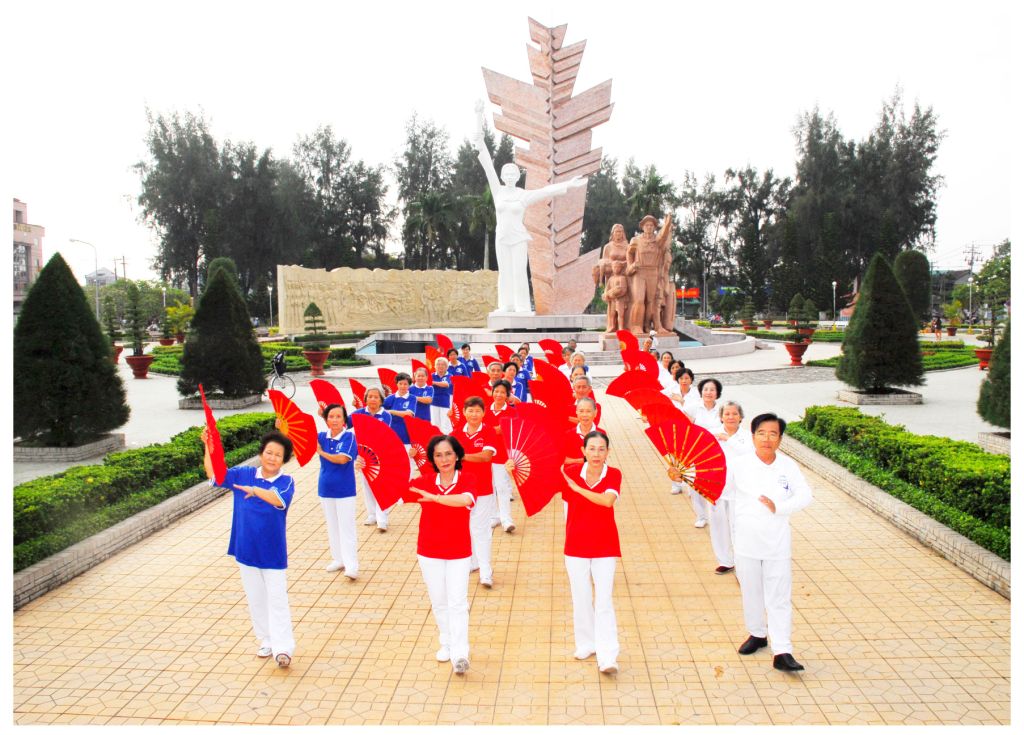
Dong Khoi Monument
Ben Tre Church
Departure from Hung Vuong tourist pier by the Ben Tre River side, the sightseeing boat calls at the brick kilns located along the Ben Tre River, visiting the base of coconut to see peeling coconut, breaking coconut for water, coconut meat, … Enjoying coconut jam, banana candy; coconut candy, coconut wine … walking on the coconut bridge, visiting the mat craft village, journeying with the bikes or sitting on the motor-carf looking at country road scenery, orchards, or going boating, rowing along the small canal.

Enjoying Siamese coconut milk picked in the garden as well as garden fruits like, grape fruit of green skin, longan, An Phuoc plum, rambutan and small banana; Drinking honey tea, listening to music and exchanging amateurish folk song.
Lunch right in the garden with the dishes like: shaggily fried Spadefish with rice-paper cake rolling with fragrant herbs, spring rolls, free-range chicken soup with banana flower salad, coconut milk boiled shrimp, plain rice with fish sour soup, belly-fish. Coconut fried tiny shrimp, tilapia, snake headed fish. Mudfish cooked in the bowl. Coconut sprout salad and other attractive dishes. Tourist can register at Hai Ho homestay green Siamese coconut – Phu Nhuan commune.

At the end of the trip, saying goodbye to natural scenic waterways at the garden area – Seeing you back to explore something more excellent in the green trees, sweet fruit area.

Wednesday, May 1, 2013

Vietnam Travel Map

Full detail Vietnam travel map. Click on the links on the right for details of each destinations of Vietnam.

 
Sapa   (Belong to Lao Cai)

Ha Long  ( Belong to Quang Ninh)

Quang Tri
Quy Nhon
Phan Thiet (with Mui Ne)
Chau Doc
Phu Quoc   (Belong to Kien Giang)


Full detail Vietnam travel map. Click on the links on the right for details of each destinations of Vietnam.

Friday, April 5, 2013

Female General Nguyen Thi Dinh memorial


Female General Nguyen Thi Dinh was born on 03/15/1920 in Luong Hoa Commune, Giong Trom District, Ben Tre Province in a peasant family rich in tradition of patriotism. As early as childhood, Ms. Ba Dinh enlightened the patriotism, loved the people, hated the French invasion. At 16, she began participating in revolutionary activities, two years later (1938) she was standing in the ranks of the Communist Party of Indochina … In 1940, she was arrested by the French and held isolatedly in Ba Ra prison (Song Be – Binh Duong Province). Years’ imprisonment was the time she worked more resiliently. In 1943, she was released from prison and come back to Ben Tre to keep in touch with the communist Party organizations, the revolutionary organization of province. She participated in taking power in August/1945. Female General Nguyen Thi Dinh was selected as a captain by provincial party committee, to command the legendary ship without number crossing the sea to North, met Uncle Ho and asked for more weapons to southern battlefields.

During the Vietnam War against American, she was coming forward to provincial people, making the movement of resounding Rise up (17/01/1960), creating a historical turning point for the southern revolution. In 1974, she earned the rank of major general. Right after the southern liberation, she held various important positions in the Party and the state, led the people to build and develop the country in a new period. She was awarded the title “Hero of the People’s Armed Forces” by the Socialist Republic of Vietnam. She died in 1992.

Female General Nguyen Thi Dinh memorial was built at her homeland in Phong Dien Hamlet, Luong Hoa Commune, Giong Trom district. Far from Ben Tre City about 8.5 km on Provincial Road 885 East. This is one of the cultural and historical education monument contributing to the patriotic tradition of the people of Ben Tre. Every year, on 28/7 (Lunar Year) her death anniversary is formally held here to commemorate the merits of an outstanding leader of the Party, the state, a female general of  Tel: 075.3862214.

Ben Tre Museum

Ben Tre Province Museum at 146 Hung Vuong Street, Ward 3, Ben Tre city, built by French colonial architecture (Architecture classique), was over 100 years ago. This is a rare ancient house remaining on the land of Ben Tre.

Ben Tre Province Museum was established in 1981, in an area of 14,000 m2, the exhibition area of 474 m2 with rich images and artifacts through two wars to defend the country of Ben Tre People and army. The ground floor consists of three rooms: Relics in Ben Tre were recognized as national monuments by the Ministry of Culture and Information, famous celebrities on the earth of Ben Tre; revolutionary youth organization of Vietnam in comrades association; and the first Branch of Party in Ben Tre was born; activities of the Provincial Party Committee, the resistance forces and the people in the period 1954 - 1960 … the floor consists of three rooms: the Dong Khoi in 1960 and 1964; military and people struggle in the south and Ben Tre Province form 1964 to 1968; Ben Tre people and army insurgency during the Tet (New Year) in 1968 to complete victory in the spring of 1975. There is exhibition gallery on economic achievements, social culture, the country’s defence of Ben Tre which come from the ruins of war.

Tel: 075.3822735