Pages

Sunday, March 13, 2011

The Sound of Woven Water: Losing Your Way in the Floating Forests of the Mekong Delta

The first thing that hits you when you enter the flooded cajuput forests of Trà Sư at seven in the morning is the texture of the air. It does not feel like the open, breezy coast or the thin, sharp mist of the northern frontiers. It is a dense, warm, breathing atmosphere that smells intensely of wet peat, sweet wild honey, and the faint, vanilla-like aroma of millions of blooming white melaleuca blossoms.

You sit completely still on the low wooden bench of a traditional xuồng—a slender, hand-carved rowing boat—steered by a woman whose conical hat catches the stray beams of sunlight cutting through the dense jungle canopy. As her wooden oar dips into the water, there is no splash. The boat slides across a thick, neon-green carpet of water lettuce so dense that the river looks entirely solid, like an endless meadow of liquid velvet. The only sounds are the rhythmic swish-slice of the paddle parting the green layer and the sudden, booming territorial call of a purple swamphen hidden deep within the reeds.

For the modern Western traveler, the glittering skyscraper districts of Saigon or the well-trodden beaches of the central coastline are beginning to feel like variations of a story already told. Discerning adventurers from the Americas and Europe are looking for the places where the concrete world completely dissolves into wild geography. Current global travel data reveals an unprecedented surge in conscious search trends targeting An Giang Province—the mystical, water-logged western frontier of the Mekong Delta where the mountains meet the floodplains.

An Giang is a profound geographical contradiction. While most of the Delta is completely flat, this province is dominated by the Thất Sơn (The Seven Mountains), a collection of sudden, sacred granite peaks that rise vertically out of thousands of acres of emerald rice paddies. It is a land defined by the rising and falling of water, an ancient cultural crossroads where the traditions of the ethnic Khmer, Cham, and Kinh people have spent centuries intertwining. It is not a place you visit to check sights off a list; it is a world you slip into to watch time follow the pulse of the river.

The Monks of the Palms: Sacred Geometry and Highland Silence

To truly understand the human landscape of An Giang, you must ride past the bustling river ports and climb into the quiet, dust-blown lanes of Tri Tôn, near the Cambodian border. Here, the landscape changes dramatically. The dense cajuput swamps give way to dry, sandy soil punctuated by thousands of towering, ancient Thốt Nốt (Palmyra palm trees). Their jagged, fan-shaped silhouettes cut sharply against the white-hot afternoon sky like ancient guardians of the plain.

The true pulse of this borderland can be found inside the pristine, white-walled courtyards of the region's ancient Khmer Theravada pagodas, such as Chùa Xà Tón. The architecture here is a masterclass in elegant, spiritual geometry—sweeping, multi-tiered orange roofs that terminate in sharp, golden serpent tails pointing toward the clouds.

The resident monks, wrapped in vibrant saffron-colored robes, possess a quiet, unbothered gentleness. Their eyes are calm, reflective, and completely detached from the frantic pace of digital life. They do not speak in the high-energy, rapid-fire cadence of the cities. Instead, their presence is a lesson in silence.

If you wander into a pagoda courtyard during the midday heat, a novice monk might nod politely, his bare feet moving silently across the cool terracotta tiles, and invite you to sit under the deep shade of a sacred Bodhi tree. He will crack open a fresh, ice-cold palmyra fruit, scooping out the translucent, gelatinous kernels for you to eat. The flavor is remarkably subtle—mildly sweet, exceptionally refreshing, and carrying the crisp taste of the deep desert soil. It is an act of hospitality that requires no words, yet bridges the gap between worlds completely.

Fire, Mud, and the Aromas of the Border Market

The cuisine of An Giang is completely unique, shaped entirely by the heavy seasonal floods of the Mekong River and the unique wild herbs gathered from the slopes of the Seven Mountains. It is a culinary language that values fermentation, intense aromatics, and rustic cooking over open flames.

The Aromatic Symphony of Gà Đốt Ô Thum

Deep within the valleys surrounding the Ô Thum lake, local families prepare Gà Đốt (Cambodian-style roasted chicken), a culinary masterpiece that demands patience. A free-range mountain chicken is rubbed intensely with sea salt, crushed garlic, wild chilies, and—most importantly—the bruised leaves of the local Chúc tree (a rare, bumpy-skinned kaffir lime native only to these mountains). The chicken is placed inside a heavy, blackened cast-iron pot over a thick bed of lemongrass stalks and fresh Chúc leaves, covered tightly, and buried under a mountain of dry rice husks that are set on fire. The pot acts as a subterranean oven, trapping the natural oils of the bird. The result is an incredible contrast: skin that is shatteringly crisp and smoky, and meat that is deeply infused with a sharp, citrusy perfume that lingers on your fingertips for hours.

The Golden Comfort of Khmer Fish Noodle Soup

Equally unforgettable is Bún Nước Lèo, a breakfast ritual found in the open-air morning markets. The base of the dish is a light, golden broth flavored with Ngải Bún (a wild, finger-shaped ginger root) and a subtle hint of fermented river fish paste (Mắm Bò Hóc). It is poured over fresh rice noodles and topped with flakes of sweet, wild-caught river snakehead fish, crispy roasted pork belly, and a mountain of fresh sesbania blossoms (Bông Điên Điển) that soften beautifully in the hot broth. It tastes exactly like the Delta looks—vibrant, complex, and deeply tied to the rhythm of the mud.

The Secret Corridors: Unlocking the Unseen Delta

While the floating markets capture the standard travel documentaries, the real emotional core of An Giang is found by turning off the highways onto the small dirt tracks where the water water-lilies grow wild.

The Lost Sunset of Tà Pạ Lake

High up on the rocky slopes of Tà Pạ Mountain lies a hidden, abandoned stone quarry that has accidentally become a natural masterpiece. Known to locals as Hồ Tà Pạ, this deep basin is filled with crystal-clear rainwater that has filtered through the granite mountain over decades. Because of the varying mineral deposits on the stone floor, the water changes color constantly—shifting from a deep, ink-like turquoise to a bright jade green within a few steps. Standing on the sheer rock edge at dusk, looking down at the mirror-like water while the distant sound of pagoda bells echoes through the valley, is a cinematic experience that feels completely separated from the modern world.

The Midnight Shadows of the Floating Villages

For a truly immersive sensory experience, hire a small wooden longtail boat from the Chau Doc pier just as the sun drops below the horizon. Navigate through the floating houses of the Cham community, where entire families live on wooden structures built over massive, submerged iron cages where millions of fish are raised. At night, the river transforms. The water turns into a dark, moving sheet of glass reflecting the green and red lanterns of the floating homes. You can hear the low murmur of televisions inside the houses, the laughter of children playing on the wooden decks, and the deep, heavy thrum of the river current moving beneath your boat. It is a living, breathing floating civilization that operating entirely on its own terms.

The Navigator’s Ledger: Practical Intelligence for the Mekong Frontier

The Monsoon and the Mirror

An Giang dictates its own travel calendar based on the behavior of the water. The absolute most spectacular window for Western travelers is the Flooding Season (Mùa Nước Nổi), which typically runs from September to November. During these months, the Mekong River overflows its banks cleanly, turning the entire province into a vast, beautiful mirror of water where the palm trees appear to grow directly out of the sky. This is when the Trà Sư forest is at its most beautiful, and the local markets are overflowing with wild river delicacies. If you prefer dry, sunny skies and gentle breezes, visit from December to April, when the emerald rice fields are dry and perfect for exploring by bicycle.

The Route West

Bypass the stressful, exhausting tour buses entirely. The most seamless and exclusive way for international travelers to access An Giang is to book a private, air-conditioned luxury limousine transfer from Ho Chi Minh City directly to the border city of Châu Đốc, a highly scenic 5-hour journey across the newly completed bridges of the Delta. Alternatively, for those traveling between Vietnam and Cambodia, Châu Đốc sits as the ultimate frontier port; you can board a comfortable, high-speed luxury speedboat that carries you straight up the Mekong River to Phnom Penh in just over four hours.

The Economics of the Waterlands

Because An Giang remains an authentic agricultural province rather than a commercialized tourist trap, your travel budget stretches exceptionally far, allowing you to invest directly in local families:

  • A private, two-hour guided rowing boat excursion through the Trà Sư forest: $8.00 to $12.00.

  • A massive dinner of fire-roasted Ô Thum chicken for two people: $10.00 to $14.00.

  • A jar of hand-refined, smoky palmyra palm sugar bought directly from a farmer: $3.00 to $5.00.

  • A night at a beautiful boutique eco-lodge tucked into the base of Sam Mountain: $55 to $110 per night.

Cultural Etiquette and Water Protection

This is a deeply spiritual border region with proud cultural boundaries. When visiting the Theravada pagodas, conservative attire that completely covers your shoulders and knees is strictly mandatory. Never step onto the raised wooden threshold of a monk's quarters with your shoes on; leave them at the base of the stairs. An Giang’s water systems are highly fragile; single-use plastics are deeply discouraged within the eco-reserves. When interacting with the local Cham or Khmer communities, a gentle bow with your hands pressed together at chest level (Sampeah) is a profound sign of respect that will instantly unlock the warmest smiles you will ever experience in Asia.

The Ultimate Insider Secret: If you stay near Châu Đốc, challenge yourself to climb the stone stairs of Sam Mountain at precisely 4:30 AM. Skip the main cable car and follow the old pilgrim path that cuts past small, rock-carved shrines smelling of sandalwood incense. When you reach the rocky summit just as the first line of daylight breaks, look westward. The international border completely vanishes. Below you lies a vast, infinite patchwork of thousands of flooded rice fields stretching deep into Cambodia, completely covered in a thin, glowing pink mist. As the morning sun hits the water, the entire world below turns into a sheet of liquid gold, and you will realize you are looking at the true, unpainted cradle of Southeast Asia. It is a moment of pure, echoing clarity that will make your heart beat to the rhythm of the river forever.

Tuesday, March 8, 2011

Ha Giang: The Northern Frontier Where Vietnam’s Wild Heart Beats Loudest

The road twists sharply upward, engine humming as mist clings to jagged peaks that disappear into the clouds. One moment you’re surrounded by emerald rice terraces carved into impossible slopes; the next, sheer cliffs drop away to reveal valleys so vast they make your chest tighten. The air is cooler, thinner, laced with woodsmoke from distant Hmong villages. This is Ha Giang, and it doesn’t just impress you — it humbles you, rearranges your sense of scale, and leaves an imprint that feels permanent.

While many travelers still stick to the classic coastal route, American and European adventurers are increasingly drawn to this remote northern province. In 2026, Ha Giang stands out as the place for those seeking raw, cinematic beauty paired with deep cultural encounters that feel earned rather than packaged.

The Road That Becomes the Destination

The legendary Ha Giang loop is more than a drive — it’s a multi-day journey into Vietnam’s most dramatic highlands. Motorbiking (or riding pillion with an Easy Rider) lets you feel every curve as you weave through the Dong Van Karst Plateau, a UNESCO Global Geopark where limestone formations create a moon-like landscape unlike anywhere else in the country.

Stop at viewpoints where the wind whips around you and watch the light shift across layered mountains. The Ma Pi Leng Pass, often called one of Southeast Asia’s most breathtaking roads, delivers panoramas that stretch for miles — deep gorges, winding rivers, and terraces glowing golden during harvest season. It’s the kind of scenery that makes you pull over repeatedly, not for photos, but simply to stand in awe and breathe it all in.

Cultures That Still Pulse With Tradition

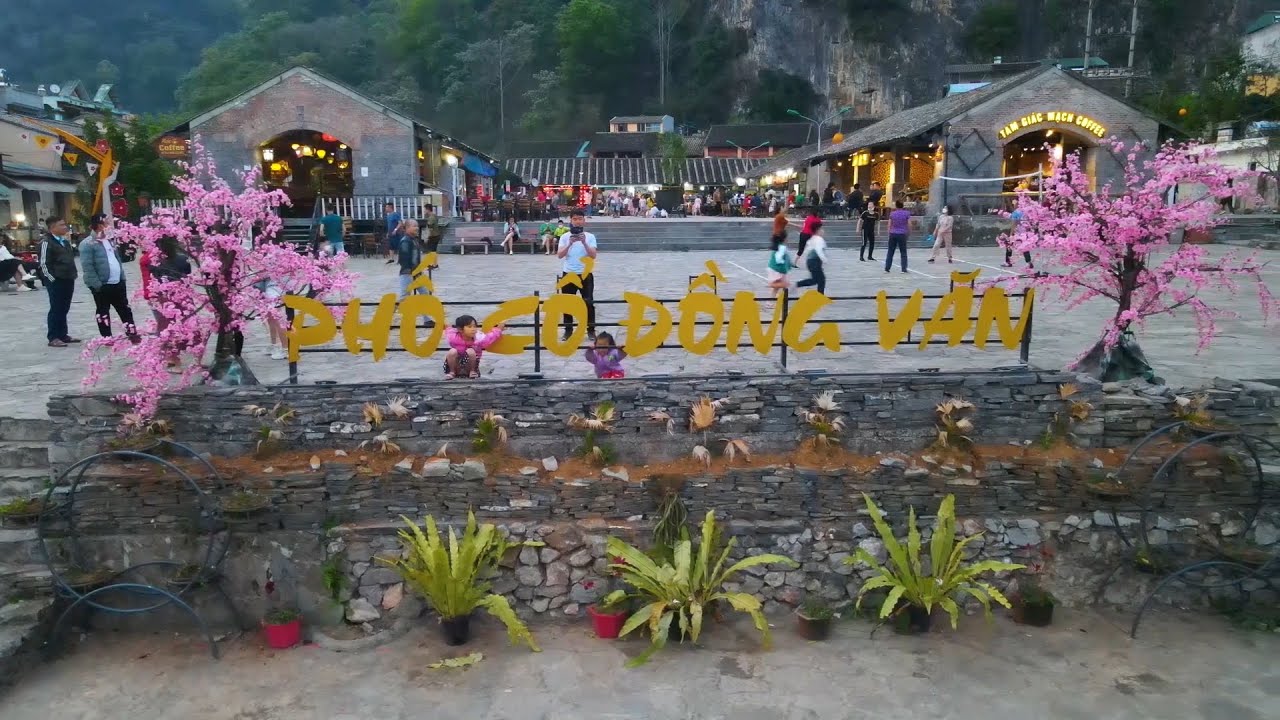
Ha Giang is home to vibrant ethnic minority communities — Hmong, Tay, Dao, and more — who have preserved their languages, clothing, and ways of life with remarkable resilience. The weekly love markets in places like Meo Vac or the vibrant Sunday market in Dong Van offer windows into living traditions: colorful embroidered garments, intricate silver jewelry, and the rhythmic sounds of haggling mixed with laughter.

The people here are tough yet incredibly warm. A grandmother in a remote village might invite you for corn wine and share stories of mountain life while her grandchildren peek shyly from behind her. There’s a quiet dignity and generosity that comes from living close to the land. Participate in a homestay, help harvest rice, or simply sit by the fire as elders tell legends of the mountains, and you’ll understand why this region feels so profoundly authentic.

Flavors Forged in the Highlands

Food in Ha Giang is hearty, fragrant, and tied directly to the seasons. Meals reflect the rugged terrain and rich soil.

Imagine sitting on the floor of a wooden stilt house as dishes emerge from the kitchen:

  • Thang Co — a bold horse meat stew (or alternatives) simmered with fragrant mountain herbs and spices
  • Fresh buckwheat pancakes stuffed with local greens and dipped in chili sauce
  • Grilled stream fish caught that morning, smoky and perfectly seasoned
  • Sweet, smoky corn wine that warms you from the inside on chilly evenings

Every bite carries the taste of elevation — earthy, vibrant, and deeply satisfying after a day on the roads.

Secret Spots That Reward Those Who Venture Deeper

Beyond the main loop, Ha Giang hides treasures that feel like personal discoveries:

  • Lung Cu Flag Tower at the northernmost point, where you can look out toward China across endless rolling hills.
  • Quiet valleys around Yen Minh or Quan Ba, where fewer travelers venture and the terraces seem to ripple like green waves.
  • Hidden waterfalls and caves accessible only by short hikes, where the only company is birdsong and the rush of water.

These places give you the gift of solitude amid overwhelming beauty — rare moments where the world feels vast and you feel wonderfully small.

When to Chase the Perfect Light

The sweetest times are March to May, when wildflowers blanket the hills in pink and white, or September to November for golden rice terraces and clearer skies. Winters bring a crisp chill and occasional frost that turns the landscape into something almost alpine, while summers are lush but wetter.

Ha Giang lies about six hours by bus or private transfer from Hanoi — a journey that gradually transitions you from city energy to mountain calm. Once there, renting a motorbike is the classic way to explore (with caution and respect for the roads), though guided tours with drivers offer comfort and local insight. Stay in charming homestays perched on hillsides or small eco-lodges where mornings begin with misty views and strong Vietnamese coffee.

Costs are remarkably accessible — hearty meals often under $10, homestays offering incredible value, and the freedom of the open road making it one of Vietnam’s most rewarding adventures for the budget.

A few gentle notes: The roads demand respect — go slow and enjoy the ride. Dress in layers for temperature changes, be culturally sensitive when visiting villages, and support local guides and businesses to help these communities thrive.

The Pull That Brings You Back

Ha Giang doesn’t offer polished perfection. It gives you something better: the exhilaration of challenging roads, the warmth of genuine cultural exchange, the quiet satisfaction of a simple meal after a long ride, and landscapes so powerful they stay burned in your memory.

In a country blessed with beauty at every turn, Ha Giang stands apart as Vietnam’s wild, untamed soul — where adventure meets authenticity and every turn in the road feels like a new revelation.

You’ll leave with dust on your clothes, stories worth telling, and a quiet ache to return to those endless mountains. This isn’t just another stop on the map. It’s a place that reminds you why we travel: to feel alive, connected, and utterly moved.

The northern frontier is calling. Will you answer? The roads are waiting, the terraces are glowing, and that unforgettable highland magic is ready to claim another heart.

Thursday, February 24, 2011

Vietnam’s Coastal Secret of Sand, Sea, and Silence: Why Quy Nhon Is Emerging as Southeast Asia’s Next Great Escape

The road hugged the coastline for miles.

On one side, emerald mountains rolled gently toward the horizon.

On the other, the South China Sea shimmered beneath the afternoon sun in shades of turquoise and sapphire.

There were no crowds.

No endless rows of beach umbrellas.

No traffic jams filled with tour buses.

Just an empty stretch of coast so beautiful it felt almost impossible that the rest of the world hadn't discovered it yet.

That was my first impression of Quy Nhon.

And judging by the growing number of international travelers beginning to include it in their Vietnam itineraries, I am clearly not the only one.

For years, visitors rushed between Hanoi, Ha Long Bay, Hoi An, Da Nang, and Ho Chi Minh City.

Meanwhile, Quy Nhon remained quietly waiting.

Now, travelers from the United States and Europe are starting to realize what locals have known all along:

Some of Vietnam's most extraordinary coastal experiences exist here.

The Beach Destination That Still Feels Authentic

Many beach towns become victims of their own success.

Popularity arrives.

Crowds follow.

Authenticity slowly disappears.

Quy Nhon has managed to avoid much of that transformation.

Despite its growing reputation, the city still feels remarkably local.

Fishing boats continue to depart before sunrise.

Markets still operate for residents rather than tourists.

Family-owned seafood restaurants remain the heart of the culinary scene.

Life here feels genuine.

Not curated.

Not manufactured.

Simply real.

For modern travelers increasingly searching for authentic experiences, that alone is becoming a powerful attraction.

The Morning That Changed My Entire Trip

The alarm sounded at 4:45 AM.

At first, it seemed ridiculous.

Who wakes up that early on vacation?

An hour later, standing on a quiet beach outside the city, the answer became obvious.

The horizon slowly turned gold.

Fishing boats returned from the night's work.

Silhouettes drifted across calm waters.

Local fishermen sorted their catch while seabirds circled overhead.

There was no audience.

No social media crowd.

No organized tour.

Only a small glimpse into daily life along Vietnam's central coast.

The experience lasted less than an hour.

Yet years later, it remains one of my strongest travel memories.

Because it felt authentic.

And authenticity is increasingly rare.

Ky Co: The Beach That Doesn't Look Real

If there is one place responsible for putting Quy Nhon onto international travel radars, it is Ky Co.

Photographs often make it appear digitally enhanced.

They aren't.

Crystal-clear water laps against pale sand.

Rock formations create natural pools.

The surrounding hills frame the coastline like a giant amphitheater built by nature itself.

On calm days, visibility beneath the water can be astonishing.

Swimming here feels less like visiting a beach and more like stepping into a postcard.

Yet even Ky Co retains a sense of tranquility that many famous beaches lost years ago.

Eo Gio: Where the Wind Meets the Ocean

Some destinations impress through beauty.

Others through atmosphere.

Eo Gio delivers both.

This dramatic coastal landscape consists of towering cliffs embracing the sea in a sweeping crescent.

Walking along the cliffside paths, visitors are treated to panoramic views of waves crashing against rugged rock formations far below.

The wind is constant.

The ocean endless.

The horizon seemingly infinite.

Standing here creates a strange sensation.

You feel simultaneously small and deeply connected to the natural world.

Few places capture that feeling so effectively.

The Hidden Villages Beyond the Tourist Trail

The real magic of Quy Nhon often exists away from famous attractions.

Explore further and you'll discover quiet fishing communities where life remains tied closely to the rhythms of the sea.

Children ride bicycles along narrow coastal roads.

Colorful fishing boats rest on beaches after long nights offshore.

Families gather beneath shaded courtyards sharing meals and stories.

Visitors are often welcomed with curiosity and warmth.

These interactions offer something guidebooks cannot provide:

Human connection.

And those moments frequently become the memories travelers cherish most.

A Culinary Scene That Deserves Far More Attention

Vietnam is globally celebrated for its cuisine.

Yet Quy Nhon's food culture remains one of the country's most underrated treasures.

Seafood dominates the table.

And for good reason.

The catch often reaches restaurants just hours after leaving the ocean.

Grilled lobster.

Sweet scallops.

Fresh squid.

Flavorful crab.

Every meal seems to carry the taste of the sea.

But local specialties extend beyond seafood.

Traditional noodle dishes, rice-based delicacies, and regional recipes reveal culinary influences unique to this part of Vietnam.

The food feels deeply connected to place.

Simple.

Fresh.

Unforgettable.

The People Who Define the Destination

Beautiful scenery may attract visitors.

People determine whether they return.

Residents of Quy Nhon are frequently described as friendly, humble, and refreshingly genuine.

Interactions rarely feel transactional.

Conversations emerge naturally.

Recommendations come freely.

Smiles appear effortlessly.

The city still retains a sense of community often lost in heavily touristed destinations.

Travelers notice this immediately.

And many cite it as one of the main reasons they fall in love with the region.

Beyond Beaches: A Rich Cultural Story

What surprises many visitors is that Quy Nhon offers more than coastal beauty.

The region contains fascinating historical and cultural layers.

Ancient Cham influences remain visible throughout the area.

Historic towers rise unexpectedly from the landscape.

Traditional festivals continue to celebrate local heritage.

Stories of maritime culture, trade, and resilience are woven into community life.

For travelers willing to look deeper, the destination reveals far more than its beaches.

It reveals identity.

When Is the Best Time to Visit?

The ideal period generally falls between February and August, when conditions are often sunny and favorable for outdoor activities.

During these months, beaches, coastal viewpoints, and marine excursions are particularly enjoyable.

However, the city's relaxed atmosphere remains appealing year-round.

Is Quy Nhon Expensive?

Compared with many coastal destinations throughout Asia, Quy Nhon offers exceptional value.

Accommodation options range from luxury beachfront resorts to affordable boutique hotels.

Dining remains surprisingly affordable.

Transportation costs are modest.

Travelers often find they can enjoy a premium experience for a fraction of what similar destinations elsewhere might cost.

Questions Travelers Often Ask

How many days should I spend in Quy Nhon?

Four to six days provides enough time to enjoy beaches, cultural sites, local cuisine, and nearby excursions without feeling rushed.

Is Quy Nhon crowded?

Compared with Vietnam's more famous coastal destinations, it remains relatively peaceful and less commercialized.

Can I explore independently?

Absolutely.

Scooters, taxis, and guided excursions make exploring both convenient and enjoyable.

The Place You'll Want to Visit Before Everyone Else Does

Travel has changed.

People are no longer searching only for famous landmarks.

They are searching for experiences.

For authenticity.

For destinations that still feel like discoveries.

Quy Nhon delivers all three.

It offers extraordinary beaches without overwhelming crowds.

Spectacular scenery without excessive commercialization.

Rich culture without performance.

And perhaps most importantly, it offers something increasingly difficult to find in modern tourism:

The feeling that you've found somewhere special before the rest of the world catches up.

One day, more travelers will undoubtedly arrive.

More articles will be written.

More photographs will appear online.

But right now, Quy Nhon still feels like a secret.

And secrets this beautiful rarely stay hidden forever.

Sunday, February 13, 2011

Shadows in the Salt: Decoding the Ancient, Slow-Motion Soul of Ninh Thuận

There is a precise moment around five in the evening when the dry wind sweeping across the plains of Phan Rang ceases to be a mere breeze and becomes an echo. It travels from the jagged, cactus-studded granite hills of Núi Chúa, carries the intense, mineral scent of sun-baked salt pans, and carries a faint fragrance of wild wildgrapes and dry earth. If you stand along the coast, the light doesn't fade—it thickens, turning the emerald waters of Vĩnh Hy Bay into a sheet of liquid amber.

While the historic alleys of Central Vietnam and the massive resort strips of the south have long occupied the itineraries of Western travelers, a quiet, culturally profound shift is showing up in international travel searches. Discriminating adventurers from the United States and Europe are looking past the predictable resort blueprints. They are seeking territories that are climatically intense, culturally preserved, and unapologetically slow. This specific search pattern is currently spotlighting Ninh Thuận Province—Vietnam’s sun-drenched, rugged southeastern frontier.

Ninh Thuận is a striking geographical anomaly: it is the driest region in Vietnam, an intoxicating hybrid of Mediterranean microclimates, dramatic coastal cliffs, and the ancient heartland of the indigenous Cham civilization. It is a destination that doesn’t cater to tourists; it invites explorers to witness an old world existing in complete harmony with the elements.

The Ceramic Matriarchy: Earth, Ash, and Ancestral Resilience

To truly feel the texture of Ninh Thuận is to leave the coast and head inland to the dusty plains of Bàu Trúc, one of the oldest continuously inhabited pottery villages in Southeast Asia. Here, the earth beneath your fingernails carries a lineage that predates the modern world.

The pottery of the Cham people is defined by a beautiful, stubborn refusal to adapt to modern technology. The artisans do not use a mechanical wheel. Instead, the creation of a vessel is an elegant, backwards dance. A woman stands before a static pedestal of clay, stepping in a rhythmic circle around the mound, shaping the damp earth with her palms, damp rags, and shells as her body moves backward.

The women of Bàu Trúc possess a striking, regal dignity, their eyes quiet and heavy with the history of their matriarchal culture. Their hospitality is entirely devoid of commercial polish; it is grounded and deeply human. They will look at your hands, smile softly at your curiosity, and guide you into their open-air workshops, explaining how their clay is harvested strictly from the banks of the Quao River and baked not in enclosed brick kilns, but in open fields under mounds of dry straw and rice husks. The resulting ceramics are unpredictable—streaked with black, brick-red, and smoky gray spots caused by the shifting wild wind during the fire ritual.

Culinary Alchemy of the Sun and Shallows

The flavors of Ninh Thuận are defined by intensity. In a land defined by sun and wind, the local ingredients pack concentrated, unforgettable profiles.

The Spicy Complexity of Phan Rang Lamb Soup

Because of the semi-arid terrain, Ninh Thuận is the only place in Vietnam where free-range sheep and goats thrive on wild coastal scrub. The signature dish, Súp Cừu Phan Rang (Phan Rang Lamb Soup), is a rich, therapeutic broth slow-simmered with mountain ginger, toasted coriander seeds, and local purple shallots. The meat is exceptionally tender and clean, absorbing the herbal punch of the broth. It is eaten hot under the shade of a neem tree, paired with fresh herbs and hand-crushed wild bird's eye chilies.

The Sweet Siphon of the Vineyard Coast

Ninh Thuận is also Vietnam’s wine country. The red grapes grown here are small, thick-skinned, and intensely tart. Locals process them into Mật Nho (Syrupy Grape Nectar) or naturally fermented, sweet artisan wines. Sipping a glass of chilled, slightly rustic local grape juice at an open-air shack while looking out at a vineyard growing directly in the sandy coastal soil is a sensory loop that feels more like the coast of Puglia than tropical Asia.

The Secret Grid: Unlocking the Unseen Coast

While the scenic coastal highway draws road-trippers, the true emotional core of the province is found down dirt tracks marked only by goat footprints.

The Lost Labyrinth of the Po Klong Garai Towers

Rising out of a lonely, cactus-lined hill outside Phan Rang town are the red-brick sanctuary towers of Po Klong Garai, built in the late 13th century. Unlike monuments that feel like museums, this is a living temple. The bricks were joined without mortar using an ancient Cham technique involving a sticky, organic vegetable resin that has baffled modern architects for decades. If you visit in the late afternoon, you will witness the silent arrival of Cham elders clad in traditional white sarongs and woven headbands, lighting candles and bathing the stone linga inside the dark inner sanctum with fresh water. The smell of incense mingling with the dry heat of the ancient bricks is hypnotic.

The Ghostly Plains of the Phương Cựu Salt Fields

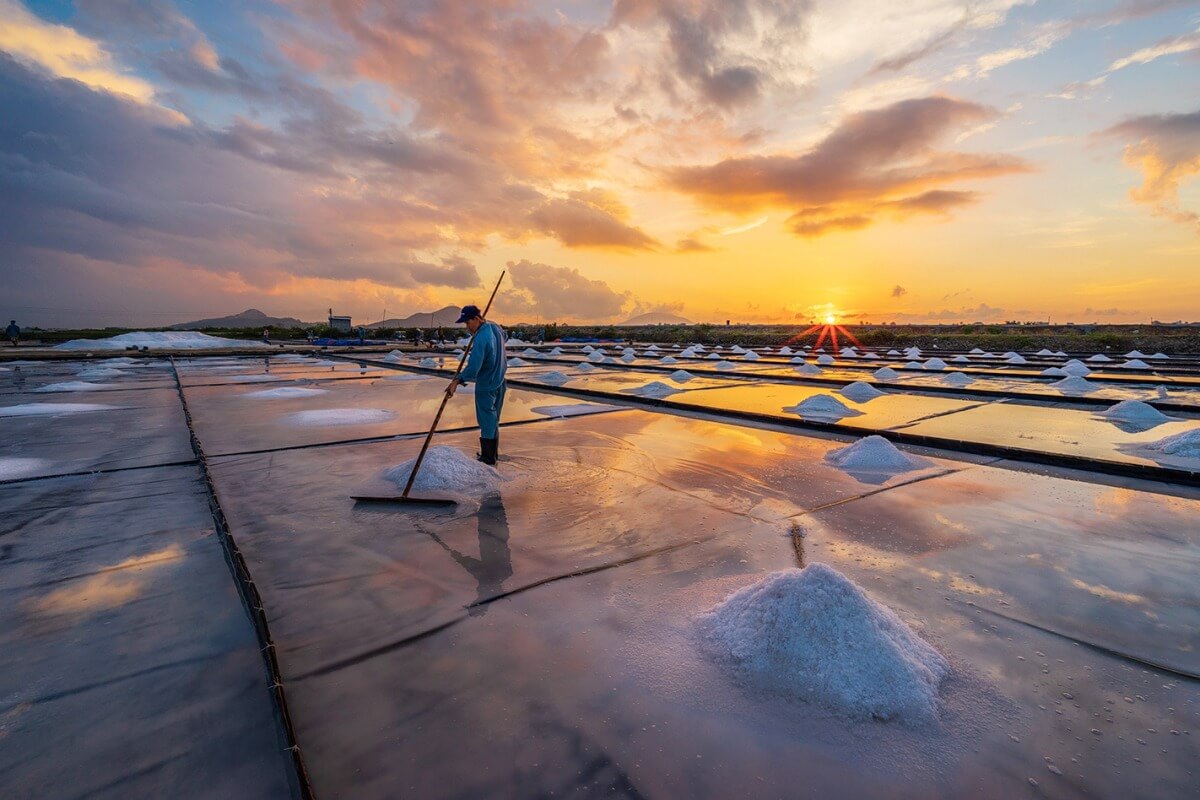
For an unforgettable experience that borders on surrealism, ride into the Phương Cựu salt pans at dawn. This is a vast, shimmering labyrinth of shallow mud flats filled with seawater. As the sun rises, the water evaporates, leaving a dazzling white crust of raw sea salt. Local salt workers, balancing long bamboo yokes over their shoulders, scrape the white crystals into perfect, glittering cones that stretch toward the horizon like miniature snow-capped pyramids. The complete stillness, broken only by the crunch of salt beneath rubber boots, creates an atmospheric landscape that feels completely removed from modern civilization.

The Explorer’s Manual: Critical Intelligence for Ninh Thuận

The Solar Calendar

Ninh Thuận proudly claims over 9 months of sun per year. The prime window for Western travelers looking for optimal weather and clear marine visibility is from January to August. During this time, the dry season ensures bright blue skies and a steady sea breeze that keeps the temperatures comfortable. September to November marks the brief monsoon season, which can bring sudden, intense downpours that refresh the arid landscape but can disrupt coastal activities.

The High-Speed Descent

Reaching this remote coast is remarkably simple. International travelers typically fly into Ho Chi Minh City or Hanoi and take a quick domestic connection to Cam Ranh International Airport (CXR). From Cam Ranh, a stunning, 1-hour private car transfer along the coastal cliffs of Núi Chúa National Park drops you directly into the heart of Ninh Thuận. Alternatively, the historic reunification express train stops at Tháp Chàm station, providing a highly romantic, slow-travel approach through the countryside.

The Economics of Arid Luxury

Because Ninh Thuận has largely avoided the traps of mass commercial tourism, it offers an incredible baseline of value, alongside pockets of world-class, ultra-luxury eco-resorts hidden inside its national parks:

  • A traditional, multi-course lunch of grilled lamb and local grape wine for two: $12.00 to $18.00.

  • A private, half-day guided boat and snorkeling trip around Vĩnh Hy Bay: $40.00 to $60.00.

  • A hand-thrown, wood-fired ceramic vase bought directly from a Bàu Trúc artisan: $15.00 to $40.00.

  • A night at a boutique eco-lodge tucked between the mountains and the vineyards: $80 to $140 per night.

Cultural Protocol and Arid Ethics

Ninh Thuận is an environmentally sensitive and culturally distinct territory. Water is a precious commodity here; practice mindful water usage at all times. When exploring the ancient Cham towers, never touch the carvings or step over the stone thresholds without removing your shoes if indicated by local worshipers. Dress respectfully, covering shoulders and knees when visiting active shrines—this simple act of mindfulness signals to the locals that you are entering their world as an appreciative student, not just an observer.

The Ultimate Insider Secret: If you explore the northern cliffs of Núi Chúa, seek out the hidden path down to Rái Cave (Hang Rái) at roughly 4:30 AM. This is not a standard cave, but an ancient, multi-tiered ancient coral reef that has been pushed above the sea level by geological pressure over millennia. As the dawn tide rushes in, the ocean swells over the smooth, moss-covered stone shelf, creating a series of natural, cascading saltwater waterfalls that drain back into the sea. Stand completely still on the volcanic stones as the first pink light turns the water into a boiling violet mist, and watch the water recede over the ancient stone. In that quiet, wild moment, you will realize that you have stepped outside the modern calendar entirely.

Friday, February 11, 2011

Ninh Binh: Vietnam’s Karst Kingdom Where Rivers Sing and Time Slows

You glide through narrow waterways in a small wooden boat, the oars dipping silently as sheer limestone cliffs rise dramatically on either side, draped in lush green vines. Birds call from hidden crevices, and the only other sound is the gentle lap of water against the hull. In that suspended moment, surrounded by towering karsts and emerald rice paddies, you realize Ninh Binh isn’t just a place you visit — it’s a place that resets something inside you.

Tucked quietly in northern Vietnam, this region is drawing more American and European travelers who crave landscapes that feel almost mythical, combined with cultural depth that goes far beyond the surface. Often called “Halong Bay on land,” Ninh Binh offers that same jaw-dropping natural drama but with an intimacy and authenticity that larger bays sometimes lack.

The Landscape That Steals Your Breath

The magic of Ninh Binh lies in its otherworldly scenery. Paddle through Trang An, a UNESCO World Heritage site, where the boat weaves under low-hanging caves and into serene valleys that open up like secret gardens. The limestone formations here tell stories of ancient seas, and the reflections in the calm waters create perfect mirrors of the sky and cliffs above.

Nearby, Tam Coc — known as the “three caves” — delivers one of Vietnam’s most poetic experiences. Rowing past golden rice fields (especially breathtaking during harvest season) with karsts standing sentinel in the background feels like drifting through a living watercolor painting. At golden hour, the light turns everything soft and ethereal, the kind of scene that makes you put your camera down and simply soak it in.

A Living Tapestry of Faith and Tradition

Ninh Binh’s spiritual heart beats strongly at Bai Dinh Pagoda, one of Southeast Asia’s largest temple complexes. The climb up through incense-filled paths to the hilltop shrines rewards you with sweeping views and a profound sense of peace. Locals here maintain deep connections to their Buddhist and ancestral traditions, and you’ll notice the quiet reverence in daily life — from morning offerings to the way communities gather during festivals.

The people of Ninh Binh carry a resilient, warm-hearted spirit shaped by their rugged yet fertile land. Farmers tend rice paddies by hand, boatmen share gentle smiles as they navigate the waters they’ve known since childhood, and families often welcome visitors with genuine curiosity and homemade rice wine. There’s an unhurried pride here, a sense that they’re stewards of something truly special.

Flavors Rooted in the Earth

Food in Ninh Binh celebrates the bounty of the land and river. Meals are hearty yet refined, using ingredients harvested the same day.

Picture sitting on a low wooden platform overlooking the fields as dishes arrive:

  • Tender goat meat stewed with fresh herbs and spices
  • Com chay — crispy rice crust from the bottom of the pot, served with savory toppings
  • Fresh river fish wrapped in banana leaves and grilled
  • Simple but explosive salads of lotus stems, peanuts, and tangy herbs

Don’t miss trying the local fermented products or joining a cooking session with a farming family — these experiences turn a meal into a memory you’ll crave long after returning home.

Hidden Corners That Feel Like Discoveries

While Trang An and Tam Coc draw attention, venture further to find quieter rewards:

  • Van Long Nature Reserve: Even more peaceful than its famous neighbors, with mirror-like waters and excellent birdwatching.
  • The ancient capital of Hoa Lu, where moss-covered ruins of Vietnam’s first dynasties sit nestled among the hills — a powerful reminder of the region’s royal past.
  • Rural villages where you can cycle through winding paths, stopping to chat with locals drying herbs or tending water buffalo.

These spots deliver that rare thrill of having a corner of paradise mostly to yourself.

When to Go and How to Experience It Best

The ideal window is from March to May or September to November, when the weather is dry and mild, the rice fields glow their brightest, and the rivers run clear. Summers bring lush greenery but more rain, while winter offers crisp air and fewer visitors.

Just two hours south of Hanoi by car or train, Ninh Binh makes an easy add-on or standalone escape. Once there, cycling or e-bikes give wonderful freedom, while private boat tours and drivers allow deeper exploration without hassle. Accommodations range from charming riverside homestays where you wake to roosters and temple bells, to boutique eco-resorts with views over the karsts.

Costs remain refreshingly reasonable — a full day of boating, cycling, and meals often fits comfortably within modest budgets, while still delivering experiences worth far more.

A few thoughtful tips: Wear comfortable shoes for gentle hikes, respect temple etiquette, and support family-run operations to help preserve the area’s character. The occasional light rain only enhances the misty, romantic atmosphere.

Why Ninh Binh Lingers Long After You Leave

In Ninh Binh, you don’t just see dramatic scenery — you move through it, breathe it, and become part of it for a while. It’s the quiet strength of the cliffs, the resilience of the farmers, the pure joy of a simple meal shared with new friends, and the way the landscape makes everyday worries feel wonderfully small.

This is Vietnam at its most balanced: nature’s grandeur meeting human warmth. You’ll depart with stronger legs from the climbs, a calmer mind from the rivers, and a heart fuller from the connections made.

If you’re seeking a destination that surprises you with its depth and beauty, Ninh Binh might just become your favorite chapter of any Vietnam journey. The boats are waiting on the water, the paths wind invitingly through the valleys, and that unforgettable feeling of awe is ready to greet you.

What are you waiting for? This karst kingdom has been patiently holding its magic — now it’s your turn to discover it.

Monday, February 7, 2011

The Island Most Travelers Fly Over—but Shouldn’t: Why Con Dao Is Vietnam’s Most Soul-Stirring Escape

There are islands that entertain you.

There are islands that help you relax.

And then there are islands that change the way you see the world.

Con Dao belongs to the third category.

The first thing you notice isn't the beach.

Not the water.

Not even the extraordinary silence.

It's the feeling.

A feeling that somehow, despite all the places you've visited and all the photographs you've seen, you've arrived somewhere genuinely different.

The airplane descends over a chain of emerald islands floating in a sea so intensely blue it almost looks artificial.

Dense jungle stretches toward untouched coastlines.

Tiny fishing boats drift through crystal-clear bays.

Roads disappear into tropical forests.

From above, Con Dao doesn't resemble a tourist destination.

It looks like a secret.

And perhaps that's exactly why more travelers from Europe and North America are beginning to pay attention.

A Place That Was Never Designed for Mass Tourism

Unlike many famous island destinations, Con Dao never evolved around crowds.

For decades, its isolation protected it.

The result is something increasingly rare in modern travel:

Space.

You can walk along beaches where your footprints are the only ones in the sand.

You can spend hours exploring coastal roads without encountering traffic.

You can sit beneath a tree listening only to waves, birds, and wind moving through tropical forests.

Many visitors arrive expecting another beautiful island.

Most leave convinced they have experienced something far more meaningful.

The Beaches That Redefine Beauty

Travel magazines often describe beaches using the same words.

Pristine.

Crystal clear.

White sand.

Con Dao makes those descriptions feel inadequate.

At Dam Trau Beach, golden sand curves gently around a bay framed by jungle-covered hills.

The water is astonishingly clear.

You can watch fish move through the shallows without even entering the sea.

Elsewhere, hidden coves emerge along quiet coastal roads.

Some require short walks through forest trails.

Others appear unexpectedly around a bend.

The reward is often complete solitude.

No beach clubs.

No loud music.

No rows of umbrellas.

Just nature exactly as it was meant to be experienced.

Where the Ocean Still Feels Wild

Con Dao offers some of the most remarkable marine experiences in Vietnam.

The surrounding waters are protected as part of a national marine park.

Coral reefs flourish beneath the surface.

Sea turtles return to nest on remote beaches.

Colorful fish move through underwater ecosystems that remain surprisingly healthy.

For divers and snorkelers, the island feels like a hidden treasure.

Visibility is often exceptional.

Marine life is abundant.

And because visitor numbers remain relatively limited, many locations retain an untouched quality that has disappeared elsewhere.

You don't simply observe nature here.

You feel immersed within it.

The Story Most Visitors Never Expect

Con Dao's beauty tells only half the story.

Its history tells the rest.

For much of the twentieth century, the islands were known for a very different reason.

The prison system established here became one of the most significant symbols of Vietnam's struggle for independence.

Today, former prison sites serve as powerful historical landmarks.

Walking through them is an emotional experience.

The contrast between extraordinary natural beauty and profound historical memory creates something unique.

Visitors often leave with a deeper understanding not only of Vietnam's history but also of the resilience that helped shape the nation.

Few destinations combine paradise and perspective so effectively.

Hidden Corners Beyond the Beaches

Many travelers spend their days chasing coastlines.

The island's interior deserves equal attention.

Roads wind through dense tropical forests where monkeys occasionally appear among the trees.

Mountain viewpoints reveal dramatic panoramas of bays, islands, and endless ocean horizons.

Early mornings often bring mist drifting through valleys while birds announce the start of another day.

The atmosphere feels almost prehistoric.

Untouched.

Alive.

And endlessly photogenic.

Seafood Worth Crossing Oceans For

Life on an island naturally revolves around the sea.

Con Dao's cuisine reflects this beautifully.

Fresh fish arrives daily from local waters.

Grilled lobster, squid, shellfish, and crab feature prominently on menus.

Yet the best meals are often the simplest.

A small family-owned restaurant.

A table near the water.

Freshly caught seafood prepared with minimal intervention.

The ingredients speak for themselves.

Flavors remain clean, authentic, and deeply connected to place.

Dining here feels less like a restaurant experience and more like participation in local life.

The People Who Preserve the Island's Character

One reason Con Dao feels different is its people.

Residents maintain a strong connection to both the island's history and natural environment.

Many locals speak passionately about conservation.

Others proudly share stories about community traditions and island life.

Visitors are often surprised by how personal interactions feel.

Conversations happen naturally.

Recommendations come freely.

Smiles feel genuine.

There is little sense of performance.

Only hospitality.

And travelers remember that long after they leave.

When Should You Visit?

The best conditions generally occur between March and September.

During these months, the sea is often calmer and visibility for marine activities tends to be excellent.

The tropical climate allows year-round visits, but weather conditions can vary depending on seasonal patterns.

Regardless of when you arrive, the island's atmosphere remains remarkably tranquil.

Is Con Dao Expensive?

Con Dao offers experiences across a wide range of budgets.

Luxury resorts provide world-class accommodations overlooking pristine beaches.

Boutique hotels and guesthouses offer more affordable alternatives.

While transportation to the island may cost more than some mainland destinations, many visitors feel the experience justifies every dollar spent.

What you receive in return is increasingly difficult to find elsewhere:

Authenticity.

Nature.

Peace.

Questions Travelers Frequently Ask

How many days should I stay?

Four to six days allows enough time to appreciate both the beaches and historical sites without rushing.

Is Con Dao crowded?

Compared with many famous island destinations in Southeast Asia, Con Dao remains remarkably peaceful.

Can I explore independently?

Absolutely.

Scooters are popular and provide excellent access to beaches, viewpoints, and hidden corners of the island.

Is Con Dao suitable for families?

Yes.

Its calm atmosphere, natural beauty, and outdoor activities appeal to travelers of all ages.

The Luxury We Rarely Talk About

When people think of luxury travel, they often imagine five-star resorts.

Private villas.

Expensive restaurants.

Con Dao offers a different kind of luxury.

The luxury of silence.

The luxury of space.

The luxury of standing on a beach and realizing there is nobody else in sight.

The luxury of hearing waves instead of traffic.

The luxury of looking up at a sky filled with stars rather than city lights.

These experiences are becoming increasingly rare.

And perhaps that is why Con Dao leaves such a lasting impression.

Because beyond the beaches, beyond the history, beyond the tropical scenery, it offers something many travelers didn't realize they were searching for:

A chance to disconnect from the noise of the world and reconnect with the things that matter.

Once you've experienced that feeling, it becomes very difficult to forget.

Friday, February 4, 2011

The Liquid Mirror of the North: Whispers of the Jade Valley in Ba Bể

To understand the specific, hypnotic spell of Ba Bể, you have to wake up before the sun clears the limestone peaks of the Northeast. Step out onto the creaking timber balcony of a traditional stilt house in Pac Ngòi village. The entire world is completely submerged in a heavy, slate-gray silence. Below you, the valley doesn’t reveal itself through land, but through mist—a thick, slow-moving ocean of vapor that smells intensely of damp fern leaves, cold mountain stone, and the sharp, resinous ghost of woodsmoke from a hearth that has been burning for three generations. Then, as the first amber spear of daylight pierces the karst walls, the fog breaks apart in silent waves to reveal a mirror of pure, unblemished jade water.

For the modern Western traveler, the frantic race through Southeast Asia's overcrowded resort towns is losing its soul. Sophisticated wanderers from the United States and Europe are actively shifting their attention toward deep green, slow-travel sanctuaries that require a map and a bit of intent to unlock. Current real-time global search movements show an unprecedented curiosity pointing toward Ba Bể National Park in Bắc Kạn province.

This is not a landscape sculpted for easy tourism. It is a vast, geological amphitheater of primeval rainforests, subterranean rivers, and the world’s only significant freshwater lake perched nearly 500 feet above sea level inside a limestone karst basin. It is capturing the imagination of those who want to witness an ancient world operating entirely on its own calendar.

The Silent Water Keepers: Earth, Hemp, and Highland Grace

To slide onto the water of Ba Bể is to slip inside a living geological dialogue. Millions of years of tectonic patience have hollowed out this mountain fortress, leaving a three-mile-long liquid ribbon bordered by vertical limestone cliffs draped in wild lianas and prehistoric ferns.

The undisputed custodians of this valley are the Tay people, who have lived along these shores for over a millennium. The architecture of their lives is perfectly elevated. Their massive, dark-wood stilt houses (Nhà Sàn) hug the base of the mountains, built entirely without metal nails, utilizing ingenious mortise-and-tenon joints designed to gently shift with the rhythm of the mountain breezes.

The character of the Tay people is defined by a serene, unbothered dignity. Their eyes possess a calm clarity that mirrors the lake itself. Unlike the hurried transactions of the lowlands, hospitality here is an unhurried, almost meditative cultural contract. A local fisherman, navigating his traditional dugout canoe (Thuyền Độc Mộc) carved from a single tree trunk, will stop his paddle just to guide you past a shallow reef.

If you spend an evening in their village, they will sit with you on hand-woven mats around the central square hearth, serving home-distilled corn wine (Rượu Ngô) in small porcelain cups. As the night air cools, you might hear the soft, haunting plunk of the Tính lute—a three-stringed instrument made from a dried gourd shell—accompanied by the gentle, poetic cadence of Then singing. It is a musical tradition recognized by UNESCO, performed not for a stage, but to invite the protective mountain spirits into the room.

The Gastronomy of the Open Fire and Mountain Shallows

The culinary language of Ba Bể is purely elemental, focusing on textures and earthiness that are impossible to duplicate outside this specific microclimate. This is food born from the deep lake currents and the wild foraging paths of the limestone cliffs.

The Crackle of Charcoal-Roasted Lake Fish

The definitive sensory taste of the valley is Cá Nướng Pác Ngòi. Tiny, sweet-water fish no larger than a finger are caught by hand-cast nets in the deep trenches of the lake. They are cleaned, skewered on split bamboo sticks, and slow-roasted directly over white-hot hardwood charcoal embers until the skin blisters into a crisp, smoky gold. You eat them whole—bones and all—dipped into a rustic paste of wild chili, rock salt, and crushed lime leaves. The flavor is a beautiful explosion of pure river sweetness, intense woodsmoke, and a distinct herbal crunch.

The Violet Comfort of Sour Pork

Equally compelling is Thịt Lợn Chua, an ancient preservation technique developed by the highlanders to combat the unpredictable mountain winters. Tender strips of local black pork are rubbed with sea salt, mixed with cold steamed rice and local yeast, then tightly packed into clay jars sealed with clean banana leaves. Over weeks, the meat undergoes a slow, natural fermentation. When flash-fried with wild garlic leaves, it yields a flavor profile that is deeply savory, complexly sour, and incredibly rich.

Uncharted Waters: The Subterranean Secrets of Ba Bể

While the central lake attracts the daytime canoes, the true spirit of discovery belongs to those who trace the water back to the dark entryways where it disappears entirely into the stone.

The Haunting Cathedrals of Puông Cave

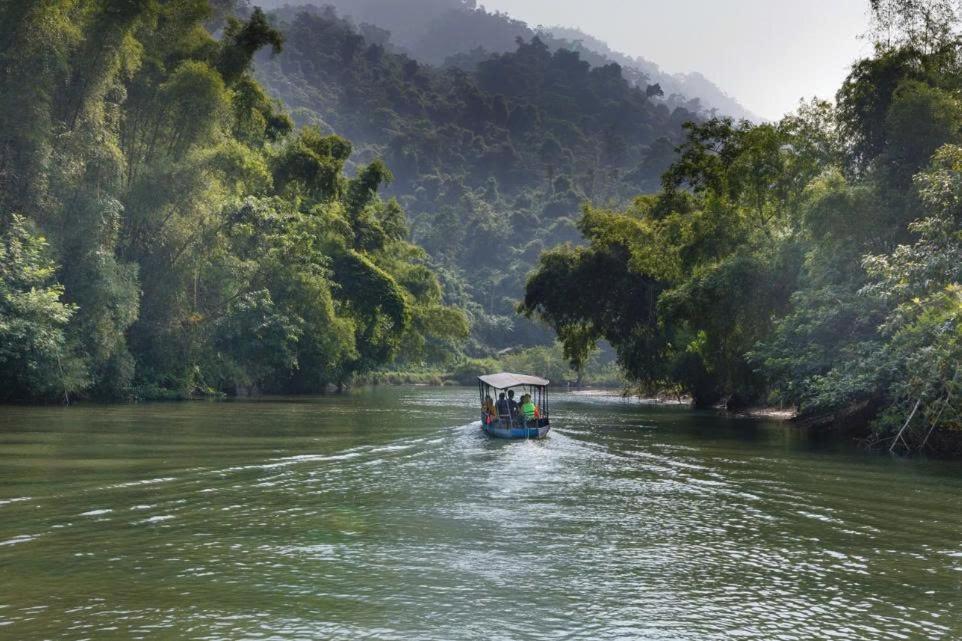
To feel the true physical weight of this landscape, take a small wooden motorboat up the Nang River until the sky suddenly vanishes. You are entering Puông Cave (Hang Puông), a colossal, 300-meter-long tunnel bored straight through the limestone core of a mountain by the sheer force of the river over millions of years. Inside, the roof arches nearly a hundred feet overhead, resembling a gothic cathedral carved from wet stone. Switch off your boat’s light for a single minute. The darkness is absolute, broken only by the cold, rushing murmur of the river beneath your hull and the high-pitched, metallic chittering of over ten thousand wild bats roosting in the stalactites above. It is a visceral reminder that the earth is alive and completely indifferent to human presence.

The Jade Solitude of Pe Lầm Lake

Most visitors assume Ba Bể is a single body of water, but it is actually a trinity of connected basins. For an experience of total isolation, ask a local boatman to navigate through the narrow, reed-choked channel that leads into Pe Lầm, the northernmost pocket of the lake system. Here, the tourist boats never venture. The water changes color, turning a dark, ink-like emerald green. The towering cliffs shut out the horizon entirely, creating a silent, liquid corridor where the only sound is the rhythmic plip-plop of your paddle and the occasional splash of a giant green heron diving for its morning meal.

The Explorer’s Blueprint: Practical Operational Intelligence

The Meteorological Masks

Ba Bể is an outdoor wonderland that morphs beautifully with the weather. The prime window for Western travelers seeking crisp air, clear blue reflections, and low humidity is from August to October. This aligns with the end of the rainy season, when the lake is at its maximum volume and the surrounding terraced rice fields turn a stunning, golden color just before the harvest. Springtime from March to May offers another spectacular view, as the valley explodes with millions of white plum blossoms and wild butterflies. Avoid the deep winter months of December and January, when the mountain mist turns into a biting, damp cold that can obscure the landscape for days.

The Logistics of Descent

Bypass the stressful, chaotic transit networks entirely. The most seamless route for international travelers is to book a comfortable, private luxury limousine van from Hanoi directly to the national park headquarters, a highly scenic 4-hour drive northward via the newly updated highways. The final hour of the journey weaves through breathtaking mountain passes that offer panoramic views of the dense jungle canopy below, ensuring your transition into the wild is an artistic experience in itself.

The Economy of the Valley

Because Ba Bể remains deeply protected within a strict national conservation zone, it has escaped the aggressive price inflation of Vietnam’s coastal hubs, offering incredible value for conscious travelers:

  • A traditional, multi-course communal dinner at a Tay stilt house: $6.00 to $9.00.

  • A full-day private boat rental with an experienced local navigator: $35.00 to $50.00.

  • A handmade bamboo craft or jar of wild mountain honey: $5.00 to $12.00.

  • An authentic, beautifully restored room in an eco-lodge over the water: $40 to $75 per night.

Environmental Protocol & Sacred Space

This is a delicate biosphere. Single-use plastics are actively discouraged within the park boundaries—bring a reusable water container. When staying in a traditional Tay home, remember that the central pillar supporting the main roof beam is considered the spiritual anchor of the family; never lean your back against it or hang clothing from it. Always remove your shoes before stepping onto the raised wooden floors of the stilt houses, and accept a cup of hot green tea with both hands—it is a small gesture that signals you are entering the valley not as a consumer, but as an appreciative guest.

The Ultimate Insider Secret: If you stay in Pac Ngòi village, wait until the clock strikes 10:00 PM, when the village lights are completely turned off to conserve energy. Walk down to the old wooden boat dock at the lake’s edge. At this exact hour, because there is zero light pollution for fifty miles around, the sky above Ba Bể turns into an incredible, brilliant ribbon of stars. The pitch-black water becomes an absolute mirror, completely erasing the horizon line. As you stand on the wood, you will feel a surreal sensation of floating in the center of the deep cosmos, with the ancient limestone silhouettes holding the universe perfectly in place. It is a moment of pure cosmic clarity that will convince you that your journey into the wild has just begun.