There is a precise moment around five in the evening when the dry wind sweeping across the plains of Phan Rang ceases to be a mere breeze and becomes an echo. It travels from the jagged, cactus-studded granite hills of Núi Chúa, carries the intense, mineral scent of sun-baked salt pans, and carries a faint fragrance of wild wildgrapes and dry earth. If you stand along the coast, the light doesn't fade—it thickens, turning the emerald waters of Vĩnh Hy Bay into a sheet of liquid amber.
While the historic alleys of Central Vietnam and the massive resort strips of the south have long occupied the itineraries of Western travelers, a quiet, culturally profound shift is showing up in international travel searches. Discriminating adventurers from the United States and Europe are looking past the predictable resort blueprints. They are seeking territories that are climatically intense, culturally preserved, and unapologetically slow. This specific search pattern is currently spotlighting Ninh Thuận Province—Vietnam’s sun-drenched, rugged southeastern frontier.
Ninh Thuận is a striking geographical anomaly: it is the driest region in Vietnam, an intoxicating hybrid of Mediterranean microclimates, dramatic coastal cliffs, and the ancient heartland of the indigenous Cham civilization. It is a destination that doesn’t cater to tourists; it invites explorers to witness an old world existing in complete harmony with the elements.
The Ceramic Matriarchy: Earth, Ash, and Ancestral Resilience
To truly feel the texture of Ninh Thuận is to leave the coast and head inland to the dusty plains of Bàu Trúc, one of the oldest continuously inhabited pottery villages in Southeast Asia. Here, the earth beneath your fingernails carries a lineage that predates the modern world.
The pottery of the Cham people is defined by a beautiful, stubborn refusal to adapt to modern technology. The artisans do not use a mechanical wheel. Instead, the creation of a vessel is an elegant, backwards dance. A woman stands before a static pedestal of clay, stepping in a rhythmic circle around the mound, shaping the damp earth with her palms, damp rags, and shells as her body moves backward.
The women of Bàu Trúc possess a striking, regal dignity, their eyes quiet and heavy with the history of their matriarchal culture. Their hospitality is entirely devoid of commercial polish; it is grounded and deeply human. They will look at your hands, smile softly at your curiosity, and guide you into their open-air workshops, explaining how their clay is harvested strictly from the banks of the Quao River and baked not in enclosed brick kilns, but in open fields under mounds of dry straw and rice husks. The resulting ceramics are unpredictable—streaked with black, brick-red, and smoky gray spots caused by the shifting wild wind during the fire ritual.
Culinary Alchemy of the Sun and Shallows
The flavors of Ninh Thuận are defined by intensity. In a land defined by sun and wind, the local ingredients pack concentrated, unforgettable profiles.
The Spicy Complexity of Phan Rang Lamb Soup
Because of the semi-arid terrain, Ninh Thuận is the only place in Vietnam where free-range sheep and goats thrive on wild coastal scrub. The signature dish, Súp Cừu Phan Rang (Phan Rang Lamb Soup), is a rich, therapeutic broth slow-simmered with mountain ginger, toasted coriander seeds, and local purple shallots. The meat is exceptionally tender and clean, absorbing the herbal punch of the broth. It is eaten hot under the shade of a neem tree, paired with fresh herbs and hand-crushed wild bird's eye chilies.
The Sweet Siphon of the Vineyard Coast
Ninh Thuận is also Vietnam’s wine country. The red grapes grown here are small, thick-skinned, and intensely tart. Locals process them into Mật Nho (Syrupy Grape Nectar) or naturally fermented, sweet artisan wines. Sipping a glass of chilled, slightly rustic local grape juice at an open-air shack while looking out at a vineyard growing directly in the sandy coastal soil is a sensory loop that feels more like the coast of Puglia than tropical Asia.
The Secret Grid: Unlocking the Unseen Coast
While the scenic coastal highway draws road-trippers, the true emotional core of the province is found down dirt tracks marked only by goat footprints.
The Lost Labyrinth of the Po Klong Garai Towers
Rising out of a lonely, cactus-lined hill outside Phan Rang town are the red-brick sanctuary towers of Po Klong Garai, built in the late 13th century. Unlike monuments that feel like museums, this is a living temple. The bricks were joined without mortar using an ancient Cham technique involving a sticky, organic vegetable resin that has baffled modern architects for decades. If you visit in the late afternoon, you will witness the silent arrival of Cham elders clad in traditional white sarongs and woven headbands, lighting candles and bathing the stone linga inside the dark inner sanctum with fresh water. The smell of incense mingling with the dry heat of the ancient bricks is hypnotic.
The Ghostly Plains of the Phương Cựu Salt Fields
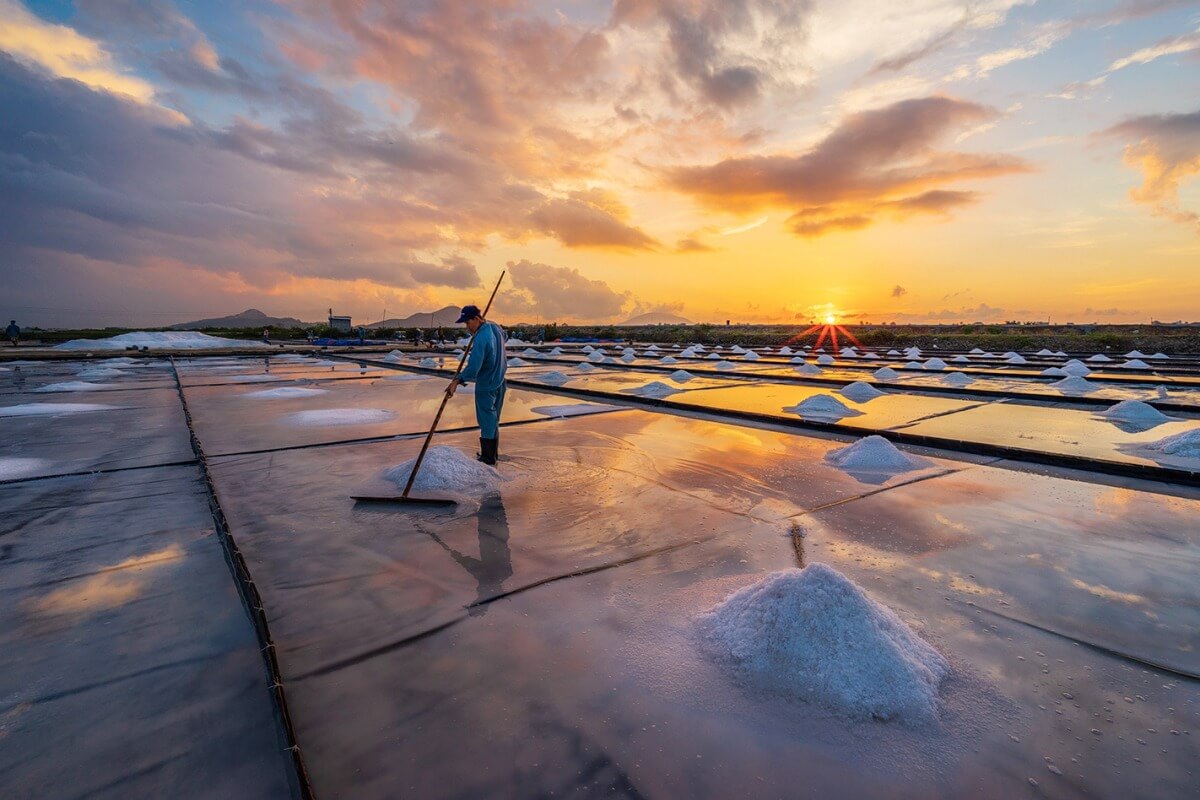
For an unforgettable experience that borders on surrealism, ride into the Phương Cựu salt pans at dawn. This is a vast, shimmering labyrinth of shallow mud flats filled with seawater. As the sun rises, the water evaporates, leaving a dazzling white crust of raw sea salt. Local salt workers, balancing long bamboo yokes over their shoulders, scrape the white crystals into perfect, glittering cones that stretch toward the horizon like miniature snow-capped pyramids. The complete stillness, broken only by the crunch of salt beneath rubber boots, creates an atmospheric landscape that feels completely removed from modern civilization.
The Explorer’s Manual: Critical Intelligence for Ninh Thuận
The Solar Calendar
Ninh Thuận proudly claims over 9 months of sun per year. The prime window for Western travelers looking for optimal weather and clear marine visibility is from January to August. During this time, the dry season ensures bright blue skies and a steady sea breeze that keeps the temperatures comfortable. September to November marks the brief monsoon season, which can bring sudden, intense downpours that refresh the arid landscape but can disrupt coastal activities.
The High-Speed Descent
Reaching this remote coast is remarkably simple. International travelers typically fly into Ho Chi Minh City or Hanoi and take a quick domestic connection to Cam Ranh International Airport (CXR). From Cam Ranh, a stunning, 1-hour private car transfer along the coastal cliffs of Núi Chúa National Park drops you directly into the heart of Ninh Thuận. Alternatively, the historic reunification express train stops at Tháp Chàm station, providing a highly romantic, slow-travel approach through the countryside.
The Economics of Arid Luxury
Because Ninh Thuận has largely avoided the traps of mass commercial tourism, it offers an incredible baseline of value, alongside pockets of world-class, ultra-luxury eco-resorts hidden inside its national parks:
A traditional, multi-course lunch of grilled lamb and local grape wine for two: $12.00 to $18.00.
A private, half-day guided boat and snorkeling trip around Vĩnh Hy Bay: $40.00 to $60.00.
A hand-thrown, wood-fired ceramic vase bought directly from a Bàu Trúc artisan: $15.00 to $40.00.
A night at a boutique eco-lodge tucked between the mountains and the vineyards: $80 to $140 per night.
Cultural Protocol and Arid Ethics
Ninh Thuận is an environmentally sensitive and culturally distinct territory. Water is a precious commodity here; practice mindful water usage at all times. When exploring the ancient Cham towers, never touch the carvings or step over the stone thresholds without removing your shoes if indicated by local worshipers. Dress respectfully, covering shoulders and knees when visiting active shrines—this simple act of mindfulness signals to the locals that you are entering their world as an appreciative student, not just an observer.
The Ultimate Insider Secret: If you explore the northern cliffs of Núi Chúa, seek out the hidden path down to Rái Cave (Hang Rái) at roughly 4:30 AM. This is not a standard cave, but an ancient, multi-tiered ancient coral reef that has been pushed above the sea level by geological pressure over millennia. As the dawn tide rushes in, the ocean swells over the smooth, moss-covered stone shelf, creating a series of natural, cascading saltwater waterfalls that drain back into the sea. Stand completely still on the volcanic stones as the first pink light turns the water into a boiling violet mist, and watch the water recede over the ancient stone. In that quiet, wild moment, you will realize that you have stepped outside the modern calendar entirely.


0 nhận xét:
Post a Comment