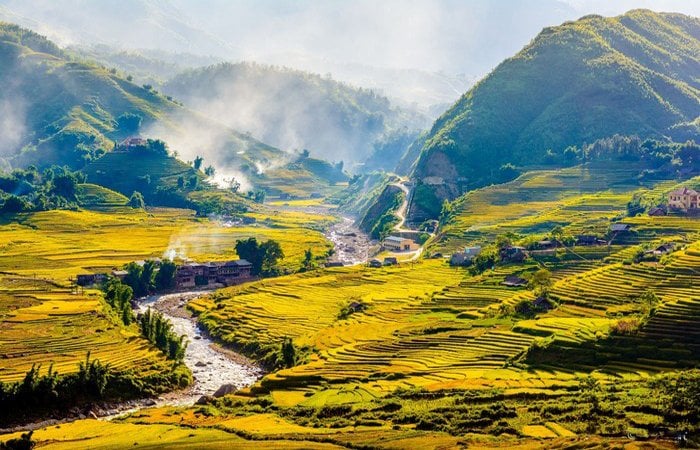
Step onto the hand-hewn timber balcony of a stilt house in the early morning, just as the subalpine air cracks open across the Mường Hoa Valley. Before the tropical sun manages to pierce the heavy canopy of the Hoang Lien Son range, you are enveloped by an atmospheric signature found nowhere else on earth. It is a dense, crisp perfume—a sensory tapestry woven from the sharp tang of fermenting wild indigo leaves, the sweet, caramel smoke of split bamboo burning in mud hearths, wet slate drying under a mountain mist, and the sharp, herbal clarity of crushed hemp stalks.
Then, look straight down into the great vertical maze below. The landscape doesn’t merely roll; it drops in a breathtaking, gravity-defying cascade of thousands of hand-sculpted mud terraces that ripple like frozen green waves down to the rushing riverbed. This is Sapa, Vietnam.
Global travel indicator algorithms show a profound, structural evolution in how international travelers are approaching Southeast Asia. While mass tourism often contents itself with the predictable beach resorts of the south or the curated old towns of the coast, premium searches from North America and Western Europe reveal an intense surge in high-intent interest for destinations offering raw ethnological depth, steep geographical isolation, and agricultural marvels. Conscientious wanderers are looking for an unhurried, deeply human connection with communities that have preserved their sovereign identity against the encroachment of the modern grid. Sapa has reclaimed its position at the absolute apex of this movement, drawing those who want to step off the asphalt and walk directly into a living, vertical empire of indigenous heritage.
The Keepers of the Hemp: Indigo Stains, Silver Torques, and the Black H’mong Lineage
To touch the real heartbeat of this alpine frontier, you must bypass the commercial center of Sapa town entirely. Follow the narrow, muddy footpaths that cling to the ridges down into the isolated hamlets of Lao Chải or Tả Van. Here, beneath the sweeping roofs of traditional timber homes built directly onto the dirt slopes, the women of the Black H’mong (Khu Mông) and Red Dao (Dao Đỏ) communities practice an art form that is nothing short of wearable storytelling.
The Black H’mong women possess a remarkable, unbothered artistic stamina. Their hands tell their story instantly—their fingers and palms are permanently stained a deep, metallic indigo-blue from decades of working with the native chàm plant. They harvest raw wild hemp, strip the stalks into thin fibers, draw them out on hand-operated wooden bobbins, and weave them into a stiff, durable canvas on simple back-strap looms.
The character of Sapa’s mountain people is beautifully characterized by a quiet, observational dignity and a deep, communal resilience. They do not approach the world with the transactional aggression of urban markets; they navigate their steep world with a calm, collective grace.
If you sit on a smooth granite boulder at the edge of a village path, a H’mong artisan might sit near you, her heavy, hand-cast silver earrings catching the mountain light as she meticulously executes an intricate batik pattern using a small copper pen (lắp tát) filled with hot, liquid beeswax. She doesn’t need to fill the silence with small talk. Through her presence, you understand that every geometric cross-stitch and spiral embroidered onto her heavy linen sleeve is an ancient tribal map—a visual lineage holding the memories of migrations, mountain spirits, and ancestors that has remained completely unbroken through centuries of colonial and modern shifts.
The Smoke of the Cast-Iron Pot: Five-Color Sticky Rice, Smoked Buffalo, and Cardamom Broths
The gastronomy of the Hoang Lien Son highlands is defined by extreme altitude and forest foraging. It is a rustic, wood-fired culinary language that values ancestral preservation methods, deep forest spices, and the intense aromas of the mountain hearth.
The Aromatic Alchemy of Thắng Cố and Mountain Herbs
The definitive culinary encounter of a Sapa mountain market is a bowl of Thắng Cố, a traditional highland stew originally perfected by the H’mong people. Pieces of local pasture-raised meat and offal are slow-simmered for hours inside massive, wide cast-iron cauldrons over an open woodfire. The broth is seasoned with an intense combination of twelve distinct forest spices, including wild cardamom pods (thảo quả), star anise, cinnamon bark, and roasted lemongrass roots. Served piping hot alongside a basket of freshly foraged mountain greens and wild mint, the flavor is fiercely rustic—deeply earthy, intensely aromatic, and perfectly paired with a small cup of potent, locally distilled corn wine (rượu ngô) to ward off the evening chill.
The Sweet Scent of Xôi Ngũ Sắc
For a beautiful sensory contrast, seek out a basket of Xôi Ngũ Sắc (Five-Color Sticky Rice), prepared by Red Dao families during local celebrations. Upland fragrant sticky rice is soaked naturally in the juices of different native mountain plants—wild magenta leaves for purple, ginger roots for yellow, and forest bark for deep red. Steamed inside hollow bamboo trunks over low wood embers, the rice retains a brilliant, jewel-like coloration. The first bite offers an exquisite texture: perfectly chewy, sweet, and carrying a delicate, herbal perfume that tastes exactly like the forested ridges that produced it.
The Shadow Ridges: Silver Waterfalls and the Silent Forest of Nam Cang
While the soaring cable car to Mount Fansipan and the stone church of Sapa town draw the weekend crowds, the true, untouched magic of the highlands belongs to those who travel to the absolute end of the valley roads, where the tourist tracks fade completely into primary jungle.
The Subalpine Cathedral of Tả Phìn Cave
For a moment of pure, isolated exploration, travel north through the ancient plum orchards to the valley of Tả Phìn. Hidden behind a steep limestone crag lies the entrance to the Tả Phìn Cave. Armed with a high-powered headlamp and guided by a local Dao elder, you slide through a narrow rock opening into a massive, multi-tiered underground cavern that stretches deep into the mountain. The interior is a labyrinth of ancient stalactites that take on the shapes of mythical dragons and stone curtains. Standing in the absolute darkness of the lower chamber, listening to the echoing drip of pristine mountain water hitting the stone floor miles beneath the surface of the earth, is a deeply grounding experience.
The Lost Valley of Nậm Cang
To escape the modern century entirely, book a private vehicle to the remote southeastern pocket of Nậm Cang. This is the furthest village cluster in the region, inhabited by the Blue H’mong and the Red Dao. Here, the modern grid dissolves. The village remains an active agricultural sanctuary where crystal-clear glacier streams rush over giant smooth boulders. Walk across a narrow bamboo suspension bridge to watch the local Dao women gather wild medicinal barks and leaves from the primary forest to prepare their famous herbal baths, while the rhythmic, heavy thumping of water-powered wooden pestles hulling rice echoes through the valley.
The Highland Compendium: Strategic Intelligence for the Alpine Trekker
The Agricultural Clock
Sapa alters its visual personality entirely based on the rhythm of the rice cycle. The absolute premier window for international travelers seeking optimal trekking conditions and the iconic golden landscape is September, when the entire Mường Hoa Valley transforms into an absolute sea of sculpted gold just before the annual autumn harvest. Alternatively, visiting from March to May offers a spectacular look at the "Water Pouring Season" (Mùa nước đổ), when the terraces act as thousands of tiny mirrors reflecting the pink and blue mountain skies as farmers flood the fields for planting. The winter months (December to February) bring a cold, dense frost and heavy mists that wrap the peaks in a beautiful mystery, though you must pack heavy technical layers for the drop in temperatures.
The Overland Ascent
Navigating to this highland sanctuary has become remarkably seamless, allowing you to avoid transit exhaustion. Located approximately 190 miles northwest of Hanoi, the most exclusive and peaceful approach is to book a private sleeper cabin on the Vic Luxury Express Train or a private luxury limousine van from the capital. The journey takes roughly 5 to 6 hours along smooth highways that trace the dramatic curves of the Red River valley, landing you at the gateway of the mountains refreshed and ready for the trail.
The Economics of the Ridge
Because Sapa’s community-based tourism heavily prioritizes local family ownership and ethnic autonomy within the villages, your travel budget directly supports the preservation of the indigenous cultures:
A traditional wood-fired mountain feast for two with local herbal tea: $12.00 to $18.00.
An original, hand-embroidered indigo linen jacket bought directly from the artisan: $45.00 to $90.00.
A private, full-day custom trekking journey led by a native H'mong guide: $30.00 to $45.00.
A private, beautifully designed eco-lodge chalet overlooking the terraced valley: $90 to $180 per night.
Mountain Protocols and Tribal Etiquette
Hearth Etiquette: The central wood fire inside a traditional H’mong or Dao stilt house is considered the sacred heart of the home. Never sit with your feet pointed directly toward the hearth fire, and never throw trash or matchsticks into the flames, as this is believed to offend the house spirits.
Artisanal Respect: When exploring the villages, you will meet many artisans offering handmade textiles. Never aggressively barter over the price of hand-woven embroidery; these pieces require months of manual labor and carry the spiritual identity of the weaver’s clan.
Trekking Footwear: The mud paths along the terraced ridges are exceptionally slick and clay-heavy, particularly after an early morning mountain mist. Abandon thin sneakers or sandals; pack professional, high-cut waterproof trekking boots with aggressive lug soles.
Sacred Gates: If you see a temporary bundle of green leaves or a woven bamboo sign (ta-leo) hanging at the entrance of a village path, it indicates the village is performing a sacred ritual to ward off illness. Respect the boundary and do not enter the village layout on that day.
The Ultimate Insider Secret: If you stay the night in the valley, make your way to the edge of the stone terrace behind Bản Giàng at precisely 5:45 PM. Sit completely still on a dry grass embankment as the sun drops behind the massive wall of the Fansipan ridge. At this precise hour, the day-tourists have returned to the town hotels, and the valley falls into a magnificent, smoking twilight. Watch the thin, white curls of woodsmoke begin to rise from beneath the thatched roofs of every hidden stilt house across the mountain face, creating a soft layer of blue mist over the rice. You will hear the distant, melodic bell of a water buffalo being guided home along the ridge, mixing with the gentle rush of the river below. In that cool, cardamom-scented air, you will realize you aren’t looking at a view—you are standing inside an ancient, living human canvas that has outlasted empires and time.


0 nhận xét:
Post a Comment