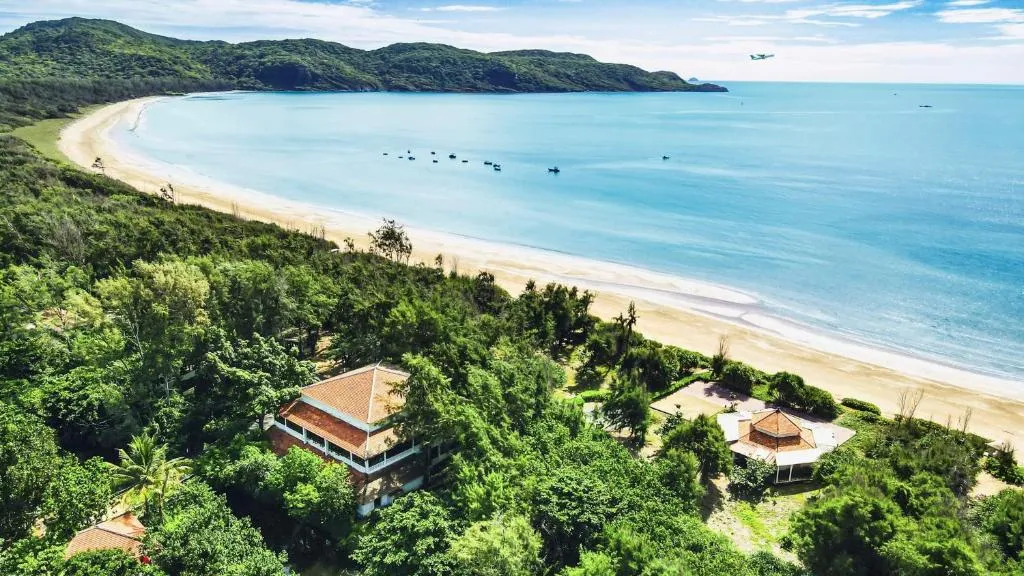
If you sit completely still on the white sands of Dam Trau beach at roughly four in the afternoon, you will witness something that borders on the cinematic. The turquoise sea moves with a slow, heavy swell, completely devoid of the chaotic jet-ski buzz found in standard tropical resorts. The wind traveling off the South China Sea smells intensely of wild salt, sweet sea grapes, and coastal pine. Then, a shadow sweeps across the water. A commercial plane drops out of the low clouds, flying so close to the sand that you can feel the engine’s vibrations in your chest before it glides onto a runway carved straight into the volcanic hills.
For the modern American and European traveler, the classic beach holiday is losing its appeal. The predictable luxury of overdeveloped resorts has surrendered to a desire for something raw, psychologically complex, and deeply quiet. This specific craving is currently driving a massive surge in international travel searches for the Côn Đảo Archipelago—a cluster of 16 volcanic islands floating roughly 50 miles off Vietnam’s southern coast.
Once known to the Western world under its French colonial name, Poulo Condore, Côn Đảo was for over a century a synonym for purgatory—a notorious prison island used by both French authorities and later regimes. Yet today, this dark history has created an accidental sanctuary. Because the islands were isolated from the mainland for so long, they bypassed the frantic concrete boom of modern tourism. What remains is a place of breathtaking, untouched biodiversity wrapped in a profound, respectful silence. It is an island where the afternoon seems to last forever, and it is exactly where you need to go to disconnect from the digital grid.
The Island Paradox: Granite Cliffs, Sacred Ghosts, and Deep Resilience
To step onto Côn Sơn—the largest and only permanently inhabited island of the archipelago—is to experience a striking landscape of contrasts. Giant, primeval granite mountains rise vertically out of the ocean, their jagged peaks permanently cloaked in heavy gray mist, while their lower slopes dissolve into brilliant coral reefs teeming with hawksbill sea turtles.
The architecture of the main town feels curiously Mediterranean yet distinctly Indochinese. Yellow-walled colonial villas stand in quiet rows under the deep shade of century-old terminalia trees (Cây Bàng), their massive roots gripping the sidewalks like ancient wooden claws.
But what truly defines the emotional atmosphere of Côn Đảo is its unique relationship with the unseen. The local residents possess a calm, remarkably gentle, and reflective character. Unlike the high-energy, fast-paced commerce of Ho Chi Minh City, life here is deliberate and unhurried. There is a collective reverence for the island's past. Locals do not view the dark history of the old prisons as a tourist gimmick; it is a sacred space.
Because of this, the island has developed a fascinating nocturnal spiritual life. While most tropical islands feature beachfront bars that roar into the early hours of the morning, Côn Đảo's nights belong to the Hàng Dương Cemetery. At midnight, hundreds of locals and independent travelers gather under the stars, lighting thousands of thin incense sticks that glow like a galaxy of fireflies in the dark. They come to pay respects to national heroes like Võ Thị Sáu, a young guerrilla fighter who became a symbol of immortal defiance. The air becomes heavy with the fragrance of fresh white lilies and sandalwood smoke, creating a communal experience that is profoundly moving and uniquely evocative.
Culinary Heritage Born of Isolation and Coral Reefs
Because of Côn Đảo’s geographical detachment, its cuisine relies entirely on the daily moods of the ocean and the hardy flora that clings to its volcanic rocks.
The Sweet Crunch of Roasted Bàng Seeds
You cannot walk twenty steps in Côn Đảo without encountering a local artisan processing Mứt Hạt Bàng (preserved terminalia seeds). Throughout the year, the giant trees drop their woody fruits, which are painstakingly collected by hand. The locals crack open the tough husks with small hammers to extract a tiny, slender kernel inside. These seeds are then slow-roasted in iron woks, either tossed with sea salt or caramelized with sugar and fresh ginger. The result is a rich, buttery flavor that tastes like a hybrid of almond and macadamia, with a distinct woody undertone—a snack found nowhere else in continental Vietnam.
Red Lobster and Moon Crabs
The surrounding marine park boasts some of the cleanest waters in Southeast Asia, rendering the seafood remarkably sweet and pristine. The ultimate indulgence here is Cua Mặt Trăng (Moon Crab), named after the bright red, circular spots that dot its golden shell. The meat is exceptionally dense and sweet, typically steamed simply with lemongrass and dipped in a rustic sauce of sea salt, black pepper, and lime juice.
Uncharted Territory: Unlocking the Archipelago's Secrets
While the historic French prisons are a mandatory pilgrimage, the physical geography of the island offers uncharted corridors for those willing to venture off the paved coastal roads.
The Secret Trek to Dam Tre Bay
To find the absolute edge of the island, seek out the hidden trailhead that cuts through the primary rainforest toward Dam Tre Bay. This is a challenging three-mile trek beneath a dense canopy of ancient hardwood trees, where you are likely to encounter the Côn Đảo black giant squirrel leaping through the branches. The trail suddenly opens up into a completely enclosed, circular mangrove lagoon surrounded by sheer bamboo cliffs. At low tide, you can wade directly into the shallow, emerald water to discover a pristine giant clam colony, their undulating, neon-blue mantles glowing beneath the clear surface in absolute solitude.
The Dawn Ritual at Cape Cá Mập
To experience a moment of pure sensory clarity, wake up at 5:00 AM, rent a vintage scooter, and ride out to Cape Cá Mập (Shark Cape) on the southern tip of the island. As the first light breaks, the massive granite face of Love Peak (Hòn Tình Yêu) emerges from the deep indigo shadows of the ocean. The morning sun turns the sea a brilliant violet-pink, and the complete absence of traffic allows you to hear nothing but the crashing of waves against the black volcanic stones below. It is a visual reset that makes the modern world feel millions of miles away.
The Traveler’s Ledger: Essential Operational Intelligence
The Climatic Balance
Côn Đảo operates on a distinct seasonal rhythm. The most spectacular window for international travelers is from March to September. During these months, the seas are calm, the turquoise waters achieve maximum clarity for scuba diving, and the winds are gentle. This also aligns with the turtle nesting season, allowing you to witness green sea turtles laying eggs on the restricted beaches of Bay Canh Island under the supervision of park rangers. From October to February, the northeast monsoon brings powerful winds and rough seas, which can occasionally disrupt flight schedules and boat transfers.
The Air Bridge
Accessing this remote sanctuary has become remarkably efficient. While brave souls can take a multi-hour high-speed ferry from Vung Tau or Tran De, the preferred route for international travelers is a smooth, 45-minute commercial flight from Ho Chi Minh City directly into Co Ong Airport (VCS). These flights use agile, twin-engine regional aircraft that offer stunning, low-altitude views of the Mekong Delta before making their dramatic approach over the island's northern beaches.
The Economics of Isolation
Because almost all goods, fresh vegetables, and fuel must be shipped from the Vietnamese mainland, costs on Côn Đảo are slightly higher than on the mainland, reflecting its exclusive, remote character:
A bowl of fresh seafood noodle soup (Bún Hải Sản) at a morning market: $3.50 to $5.00.
A bag of hand-roasted savory Bàng seeds: $4.00 to $6.00.
A 24-hour vintage scooter rental to explore the coastline: $6.00 to $8.00.
A night at a boutique, eco-conscious resort overlooking the bay: $120 to $250 (with ultra-luxury experiential options extending upward).
Crucial Island Etiquette
Côn Đảo is a highly protected national park. Plastic bags are strictly discouraged, and travelers are expected to pack out whatever non-biodegradable waste they bring in. When visiting the historic prison complexes or Hàng Dương Cemetery, conservative attire that covers the shoulders and knees is strictly mandatory. Loud laughing, shouting, or disrespectful photography within the historic sites is deeply frowned upon by the locals; treat the island with the quiet reverence it has earned over centuries of survival.
The Ultimate Insider Secret: If you explore the small pier near the town center around 6:00 PM, look for the local fishermen preparing their small wooden skiffs for night squid fishing. Approach them politely with a translator app and offer to pay for a spot on their boat. If they accept, you will spend the night floating in the pitch-black ocean under a massive green halogen light, pulling iridescent squid directly out of the deep water while the old fishermen pour you tiny cups of medicinal rice wine, sharing raw laughter under the canopy of the Southern Cross constellation. It is a memory that cannot be packaged, purchased, or duplicated.


0 nhận xét:
Post a Comment